
THE EVENTFUL UNIVERSE
Unlike the abundance and immediacy of computer-generated images, analogue practices and film-based photography offer a slower rhythm and a tactile experience, produced through cycles of material transformation and time, from shooting to final print. Watching an image appear inside the darkroom is a true chemical wonder.
By supporting this funding cycle to build a darkroom and develop a photographic project, you aren't just funding equipment; you are helping me preserve a vital, living practice.
A RESEARCH ON SILVER AND A PHOTO DARKROOM IN BERLIN
FIRST FUNDING CIRCLE
CYCLE IS OPEN — CLOSES OCT 31
Following silver production from Colonial Mexico to a sustainable darkroom in Berlin
What this cycle funds
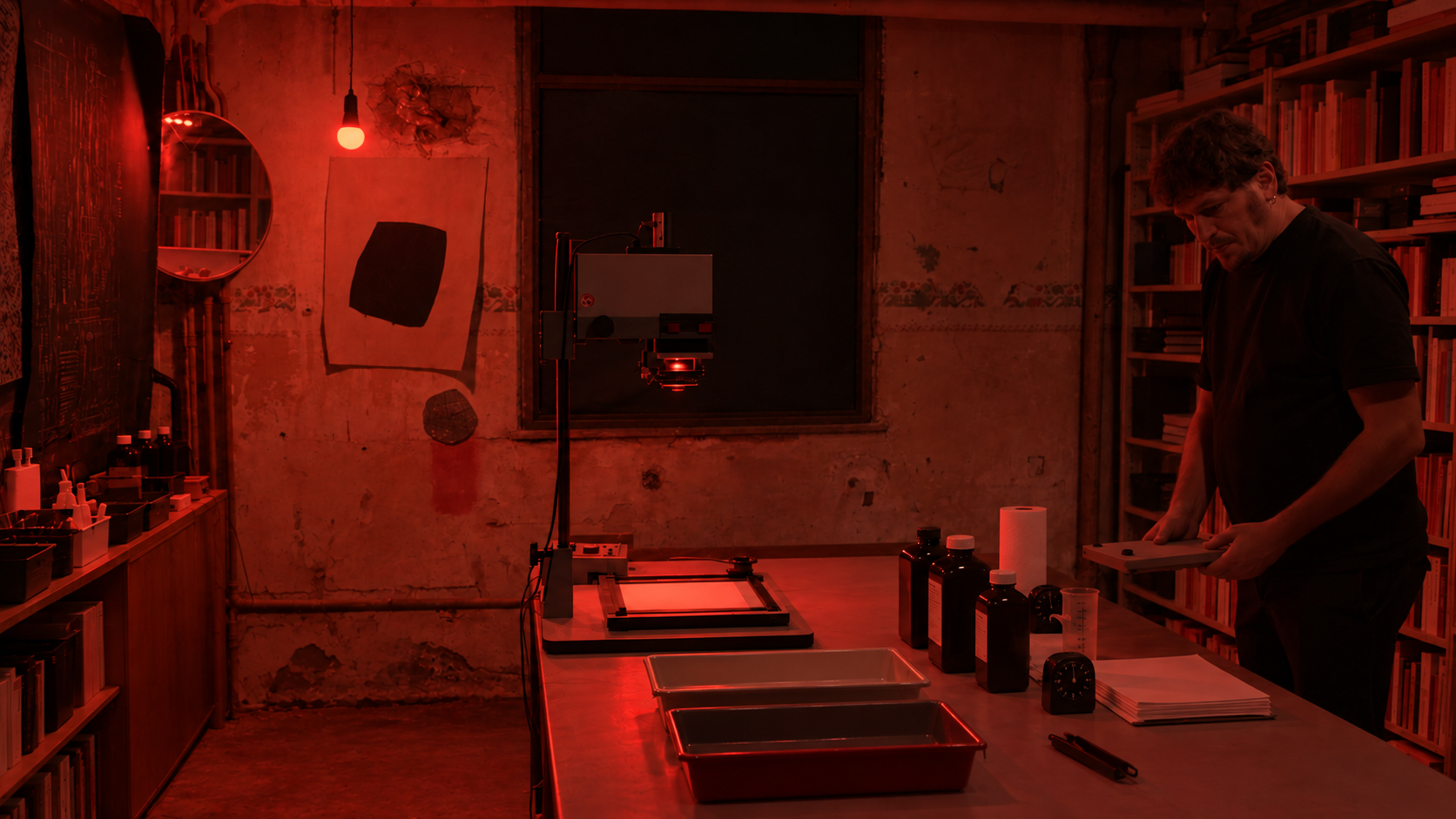
A Darkroom in Berlin
A fully equipped darkroom for working in film and silver gelatin prints. RC and Fiber paper.
It is built to hold three or four people. It can be used for teaching, for printing sessions, and for work by other artists and photographers. It is also built to recover the silver that passes through it, rather than send it down the drain.
I think hand-made objects and practices will be increasingly cherished. And seeing a photographic image appear under the developer is true chemical wonder.
Enlargers, temperature control, sink, plumbing, ventilation, safelights, trays, light-tight build, silver recovery apparatus, insulation and heating.
In January 2027, I will travel to Hidalgo and Guanajuato, particularly Mineral de Pozos, to photograph what remains of the places where silver was extracted using mercury from the 1550s onward—the process that gave photography its chemistry four centuries before photography existed. Even early daguerreotypes depended on the chemistry of silver and mercury vapours to produce. The mining procedures from colonial times were borrowed for the development of photography and Cinema in the 20th Century.
Travel, lodging, film, transport.
A Journey to the Silver Districts of Mexico
Silver Accountability
I’ll explore and adapt chemical procedures to recover silver from the darkroom's unused liquids. The value isn't in the silver recovered, but in the symbolic and material gesture of accounting for silver's use in artistic practices. Artists, let alone industries, hardly ever do this.
To extract silver (and gold), very large quantities of mercury were dumped into Mexican soil (and other parts of the Americas). All silver taken to Europe was accounted for; in contrast, none of the mercury that contaminated the soil and the workers' bodies was.
Every gram that enters this darkroom will be weighed and followed: what is bought, what leaves inside the works I send you, what is recovered from the fixer, and what is lost. To know more about this research, visit my Substack.
Chemical recovery equipment, recycling.
All patrons receive artworks—cards, photographic prints, and, in the top circles, silver recovered from making them.
Every circle, including the smallest, receives a welcome package and the closing balance.
The darkroom
46 USD
Welcome Circle
Plata—Bermellón
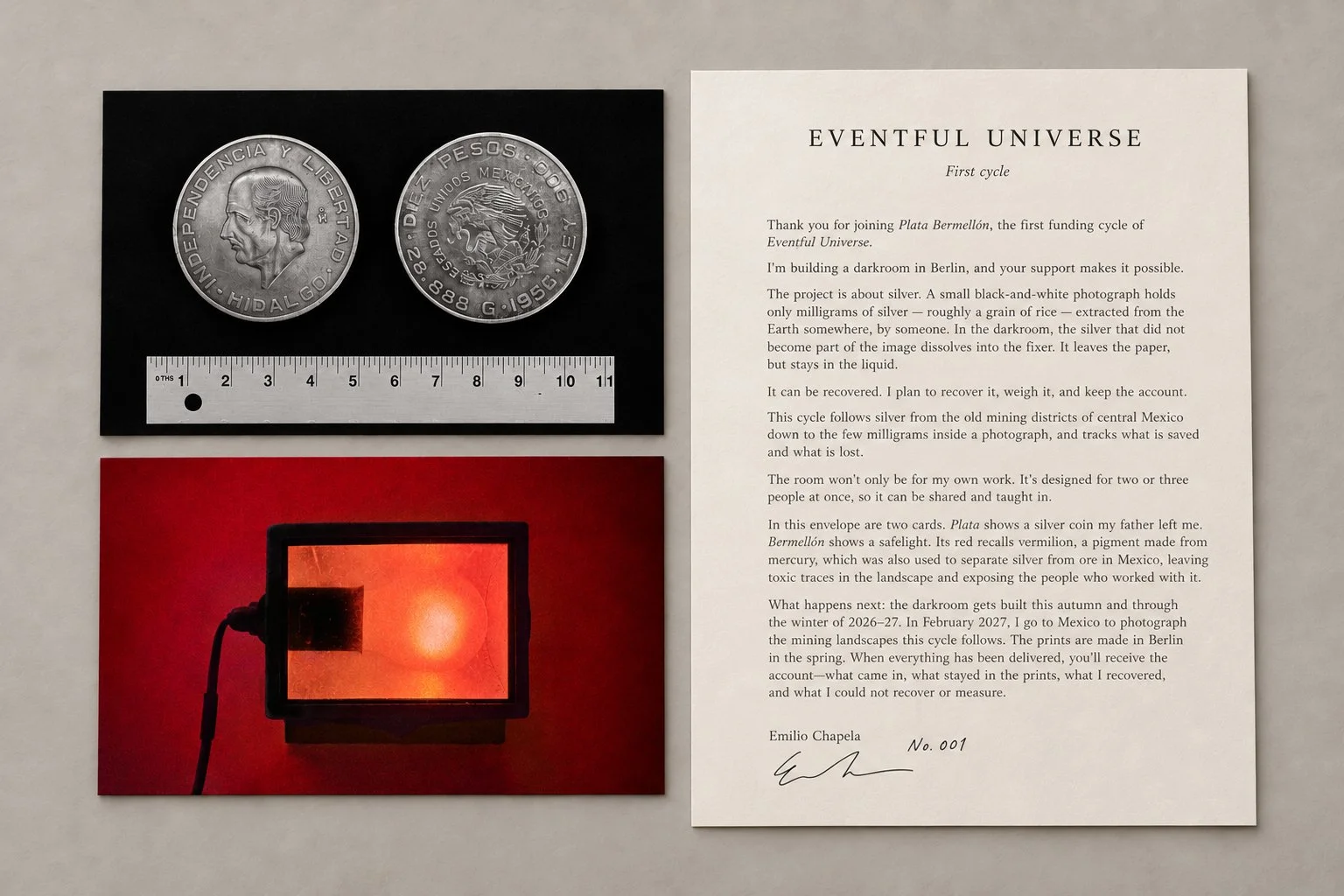
Two cards, 10 × 15 cm, printed on uncoated 350 gsm
Welcome letter, signed and hand-numbered
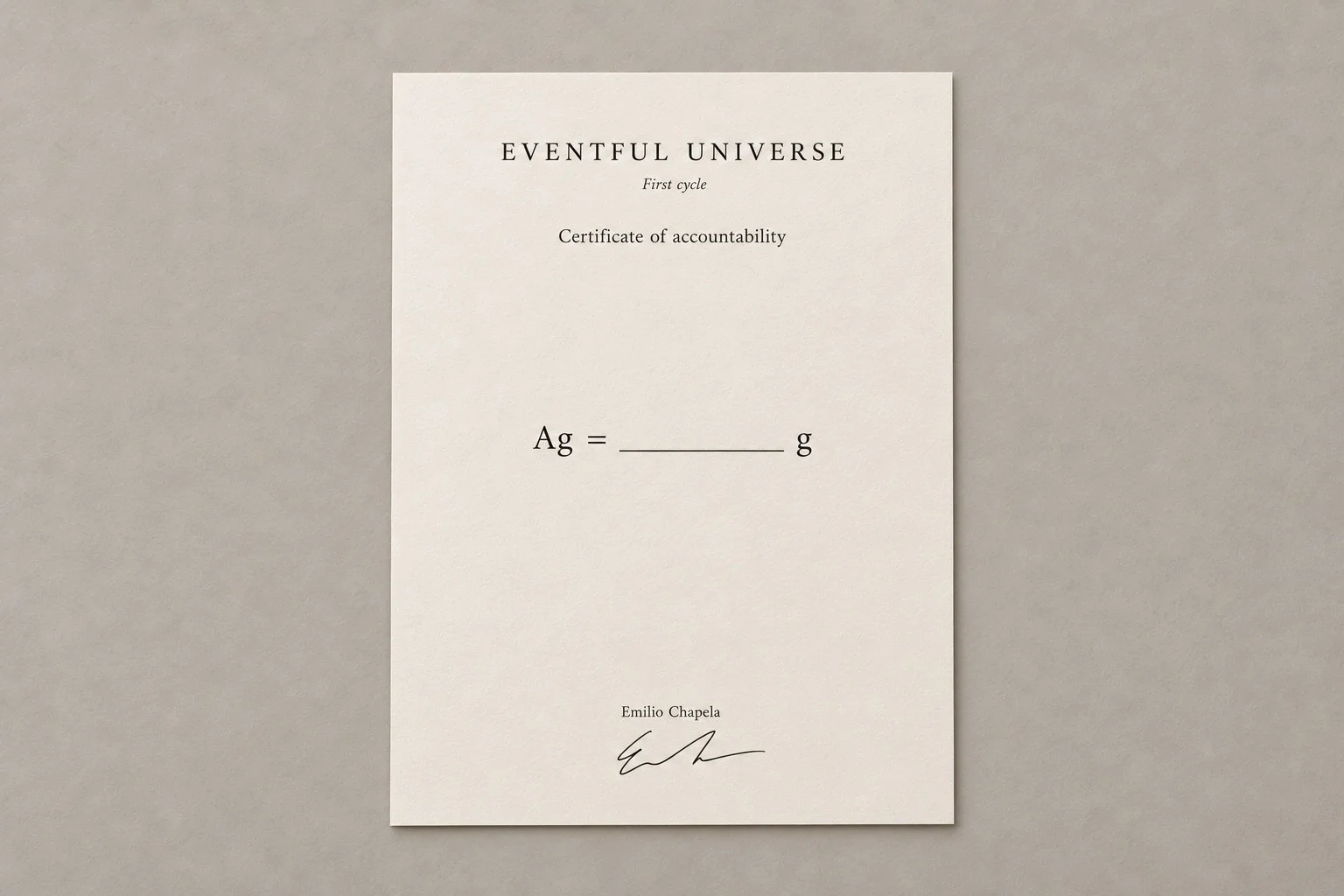
Closing balance, printed and numbered, at the close of the cycle
Welcome to the Eventful Universe.
Thanks for your support!
You will receive two cards: Plata, an image of a Mexican ten-peso coin from 1955 — 28.888 grams, ley 0.900. Photographed at actual size, both faces. It belonged to my father.
And Bermellón, a print of the safelight for the darkroom this cycle builds. Its red is the red of vermilion — which is mercury sulfide, the same mercury used to pull silver out of the ground in Mexico for four centuries, and left in the soil and in the workers who handled it.
Prints and welcome letter delivered by December 2026
We send the closing balance (certificate of silver accountability) when the cycle closes, and all works are delivered (estimated May 2027).
Shipping: Worldwide via post (to Mexico via certified post with tracking number, or delivered locally)
Welcome to the Eventful Universe.
Thanks for your support!
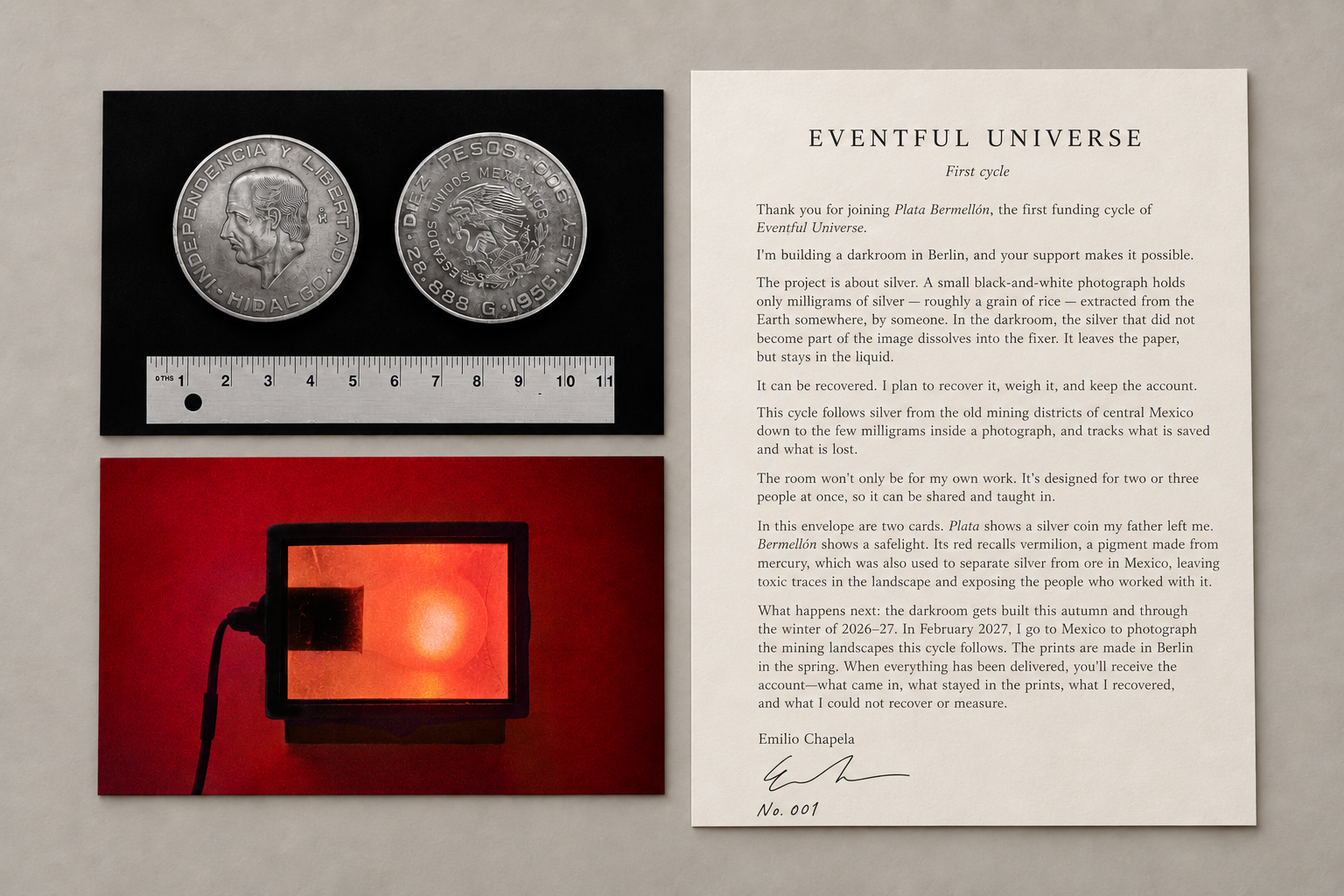
Two cards, 10 × 15 cm, printed on uncoated 350 gsm
Welcome letter, signed and hand-numbered
Closing balance, printed and numbered, at the close of the cycle
Open edition
You will receive two cards: Plata, an image of a Mexican ten-peso coin from 1955 — 28.888 grams, ley 0.900. Photographed at actual size, both faces. It belonged to my father.
And Bermellón, a print of the safelight for the darkroom this cycle builds. Its red is the red of vermilion — which is mercury sulfide, the same mercury used to pull silver out of the ground in Mexico for four centuries, and left in the soil and in the workers who handled it.
Prints and welcome letter delivered by December 2026
We send the closing balance (certificate of silver accountability) when the cycle closes, and all works are delivered (estimated May 2027).
Shipping: Worldwide via post (to Mexico via certified post with tracking number, or delivered locally)
The Concept Circle
Pure Silver
130 USD
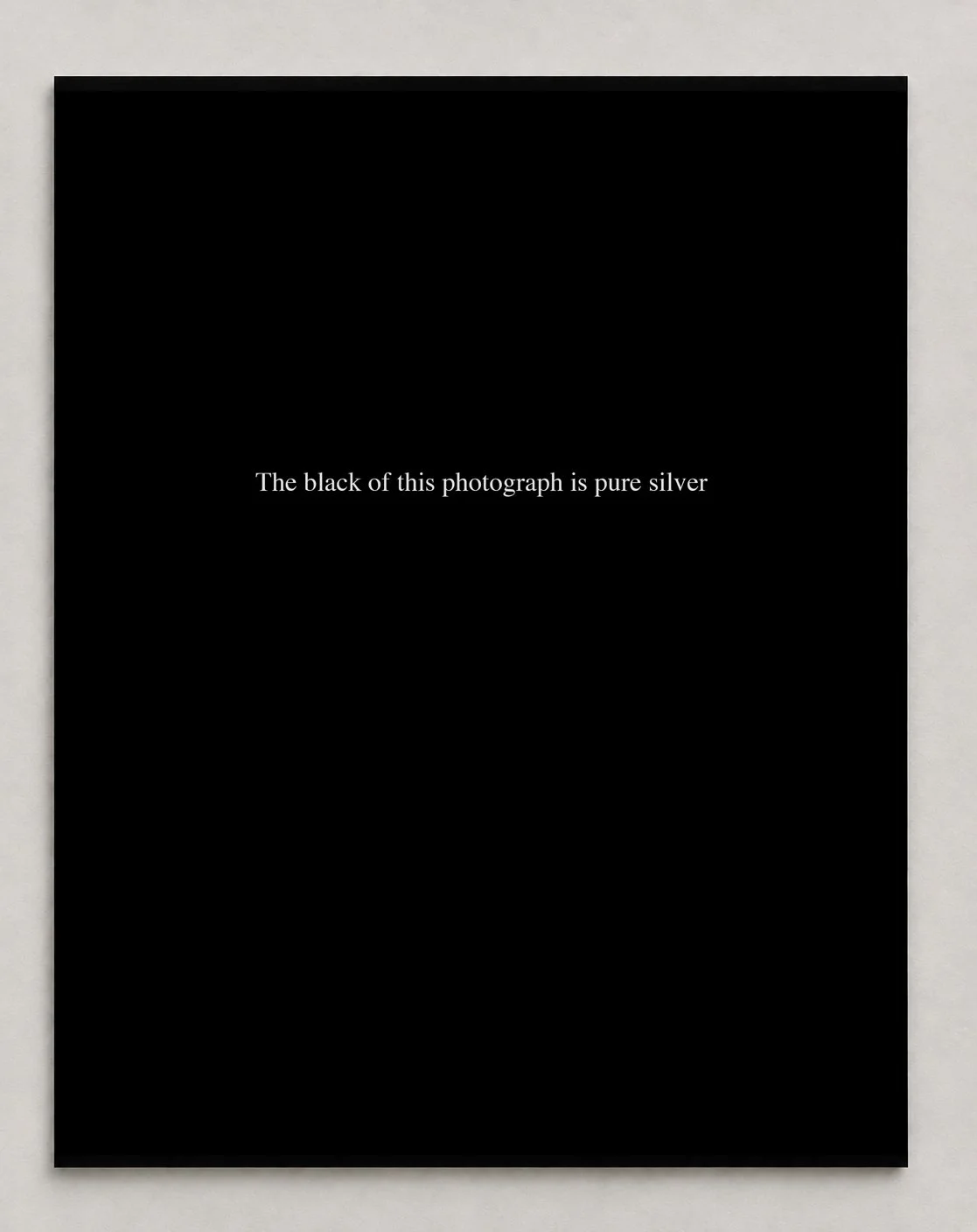
One silver gelatin photograph. Spanish or English to choose from.
20 × 25 cm (8 × 10 in)
Unframed
Edition of 25 (each language)
Also Included:
Two cards — Plata y Bermellón — and the welcome letter
Closing balance, printed and numbered, at the close of the cycle
The first circle to receive a photograph produced in the darkroom.
Traditional black-and-white photographs are made of silver.
This camera-less print is made by placing a stencil directly against light-sensitive paper and exposing it to light. Development produces a deep black surface of metallic silver, interrupted by white letters.
Because the print is almost entirely black, most of its silver remains in the paper, becoming part of the work. The white information appears where the silver is absent, making the text legible.
Print delivered in December 2026.
(including the welcome package)
Shipping: Worldwide by post. In Mexico, local delivery or courier.
The closing balance—a certificate of silver accountability—will be sent after all works have been delivered, estimated for May 2027.
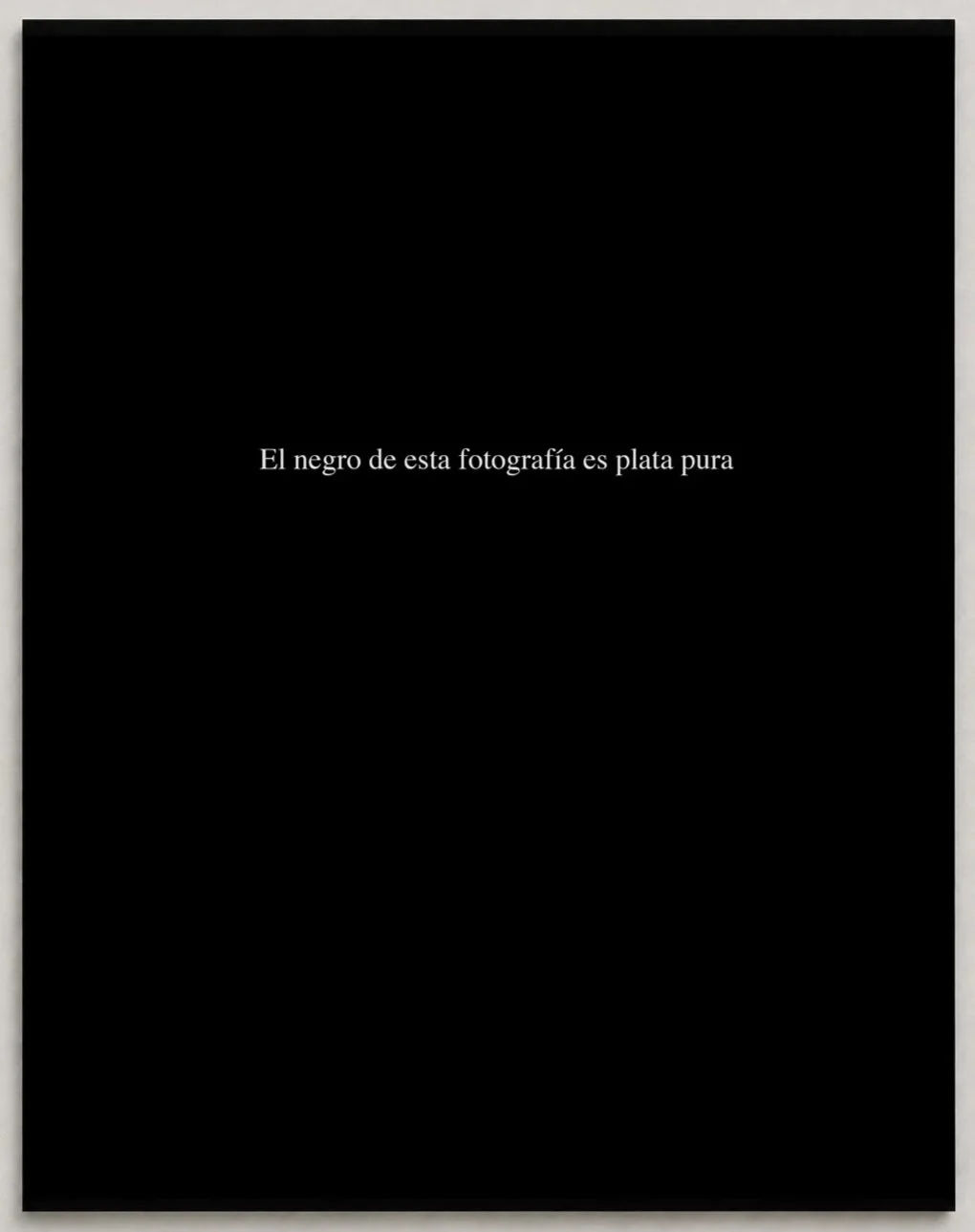
One silver gelatin photograph. English.
20 × 25 cm (8 × 10 in)
Edition of 50
Signed and numbered on the back
Traditional black-and-white photographs are made with silver. This camera-less print is made by placing a stencil directly against light-sensitive paper and exposing it to light. Development produces a deep black surface of metallic silver, interrupted by white letters.
Because the print is almost entirely black, most of its silver remains in the paper, becoming part of the work. The white information appears where the silver is absent, making the text legible.
Print and welcome package delivered in December 2026.
The closing balance—a certificate of silver accountability—will be sent when the cycle closes and all works have been delivered, estimated for May 2027.
Shipping: Worldwide by post. In Mexico, local delivery or courier.
The Patio Circle
Receta para la amalgama
750 USD
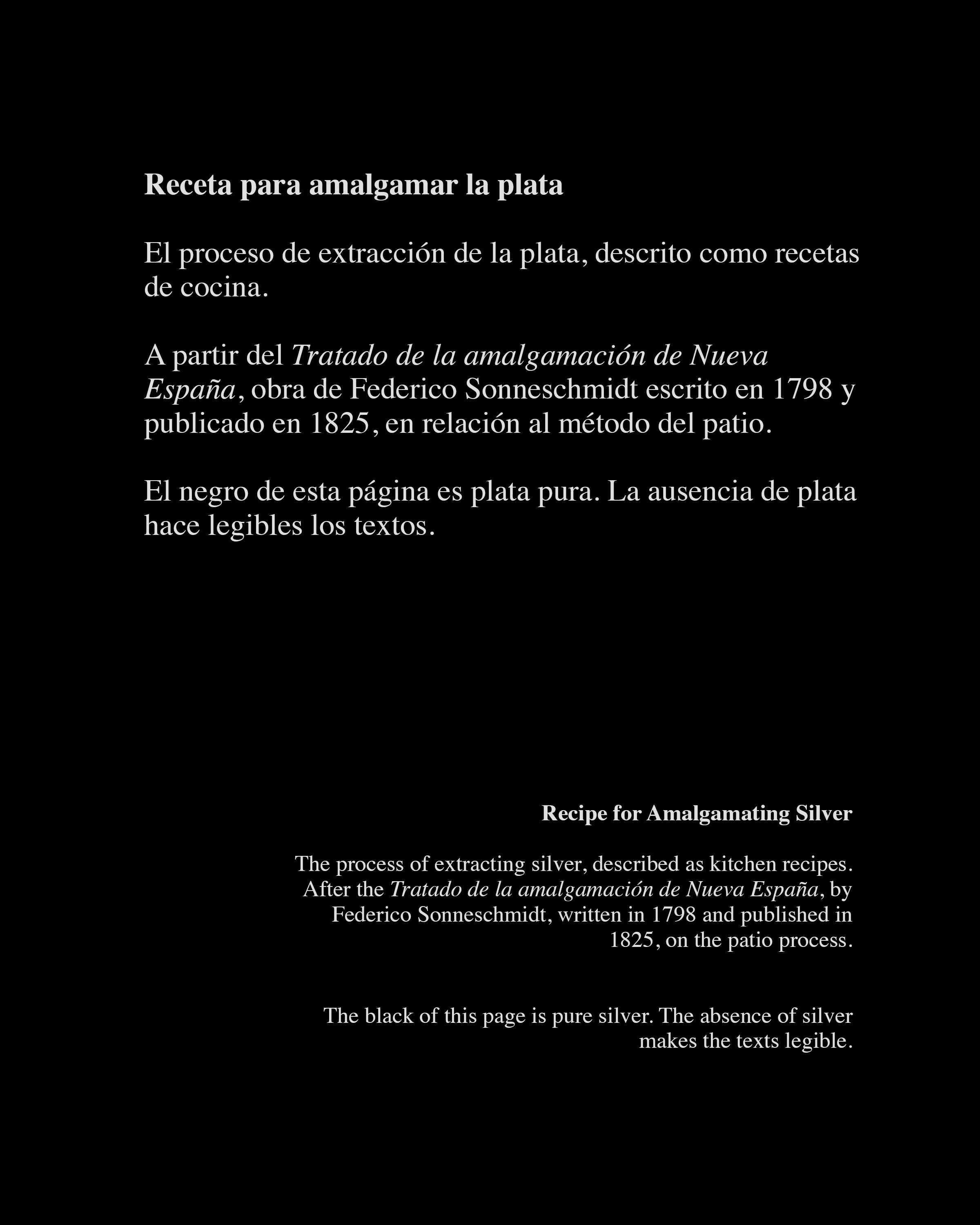
8 silver gelatin photographs. Texts in Spanish, with translation on the back.
8 prints 20 × 25 cm (8 × 10 in)
Delivered in a box. Unframed
Edition of 10
Also Included:
Two cards — Plata y Bermellón — and the welcome letter
Closing balance, printed and numbered, at the close of the cycle
My personal favourite. Recipe for amalgamating silver; instructions described as kitchen recipes. Original texts from the 16th century.
Printed in silver
8 instructions for making amalgam, taken from the manuals of the beneficio de patio — the method used across New Spain from the 1550s to draw silver out of crushed ore by mixing it with mercury, salt and magistral, then treading the mass for weeks in an open yard.
Coarse salt, or sea salt. Leave it a day or two to dissolve. Scatter it like rain. Better too little than too much. The register is a kitchen's. The operation is a mine's.
Each instruction is printed by contact onto photographic paper, without a camera, and returns as white letters on a black field. The black of the page is pure silver; the absence of silver is what makes the text legible.
Texts after the Tratado de la amalgamación de Nueva España, by Federico Traugott Sonneschmidt, written around 1798 and published in 1825.
Prints delivered in December 2026.
(including the welcome package)
Shipping: Worldwide by courier. In Mexico, local delivery or courier.
The closing balance—a certificate of silver accountability—will be sent after all works have been delivered, estimated for May 2027.
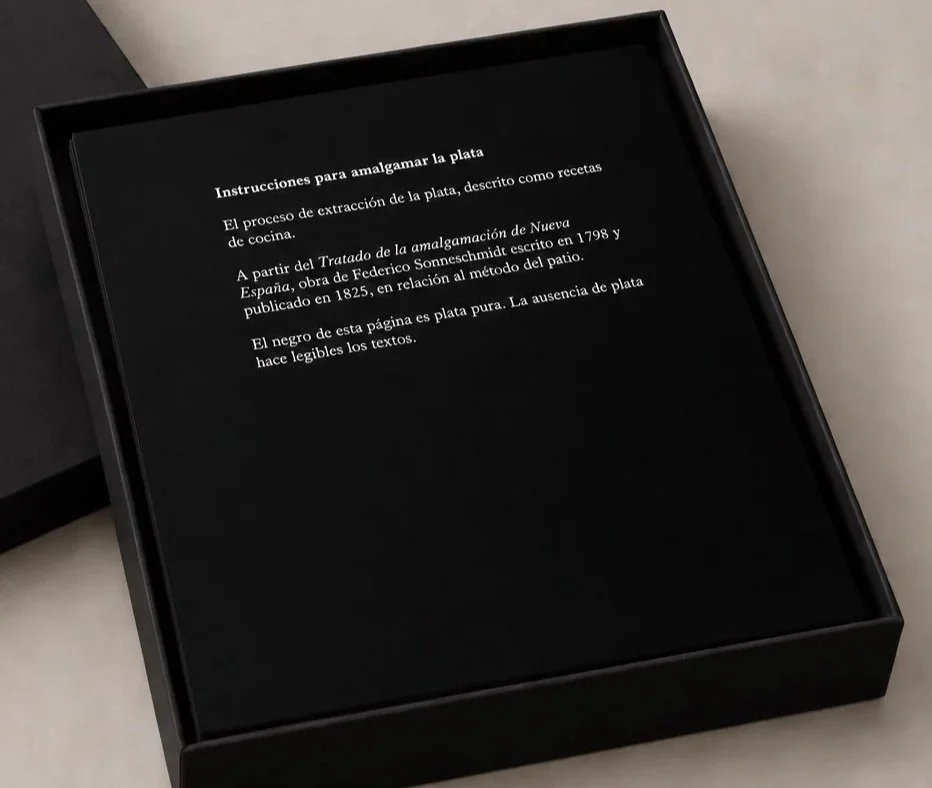
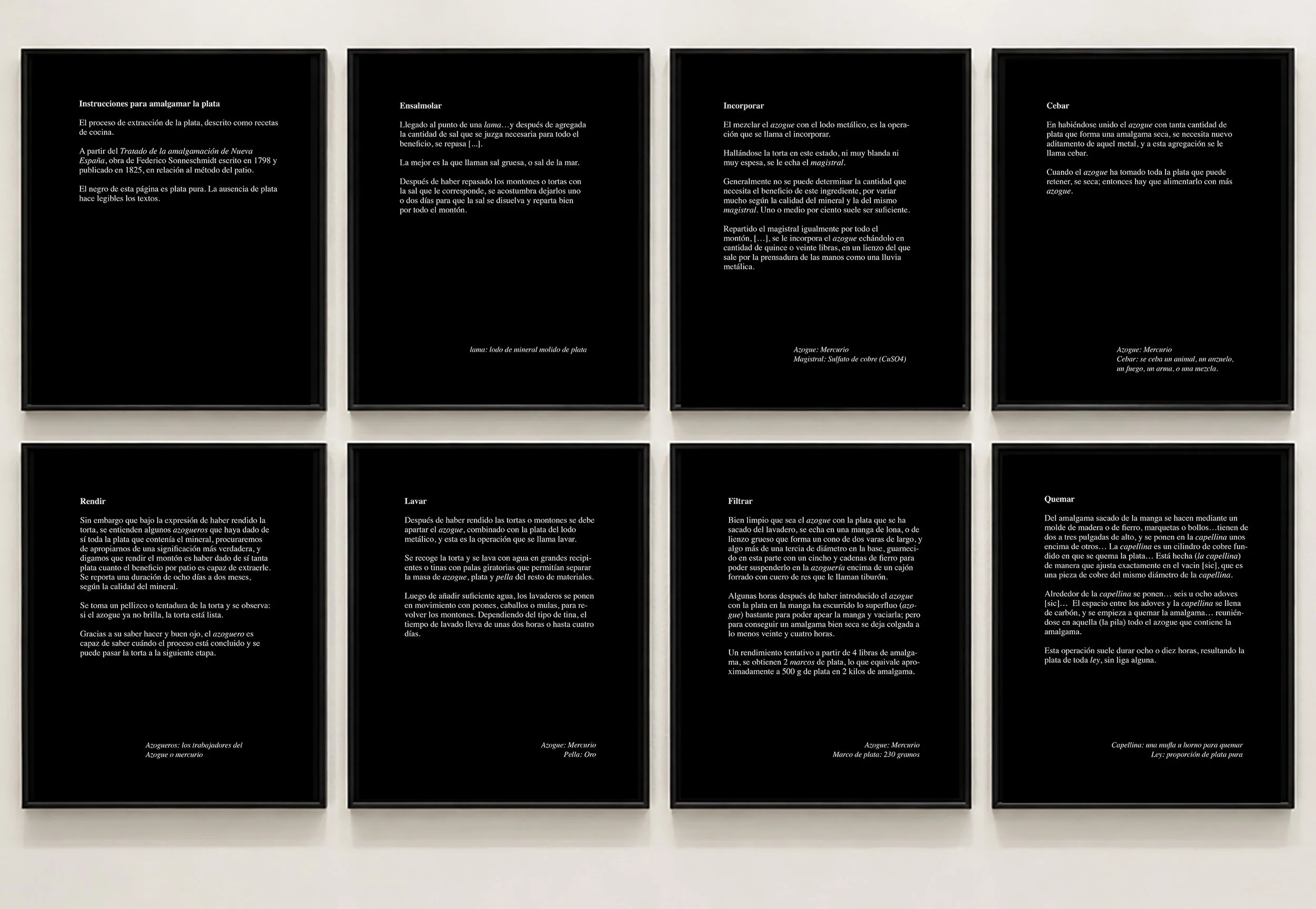
Series of 8 silver gelatin photographs. All texts in Spanish.
Translated into English on the back. 20 × 25 cm each print (8 × 10 in). Edition of 10 + AP
Delivered in a special edition box.
Also Included:
Two cards — Plata y Bermellón — and the welcome letter
Closing balance, printed and numbered, at the close of the cycle
Instructions for making amalgam, explained in 8 steps: the process of extracting silver in Colonial Mexico using mercury. Taken from the manuals of the beneficio de patio — the method used across New Spain from the 1550s to draw silver out of crushed ore by mixing it with mercury (azogue), salt and magistral, then treading the mass for weeks in an open yard.
The instructions are written somehow like cooking recipes: Coarse salt, or salt from the sea. Leave it a day or two for the salt to dissolve. Scatter it like rain. Better too little than too much.
Each instruction is printed by contact onto photographic paper, without a camera, and comes back as white letters in a field of black—the instructions are written in silver, the metal they explain how to extract.
Because the print is almost entirely black, nearly all of its silver stays in the paper and stays with the work; very little of it reaches the fixer.
Prints delivered in a box in December 2026.
Welcome package delivered in December 2026.
We send the closing balance (certificate of silver accountability) when the cycle closes and all works are delivered (estimated May 2027).
Shipping: Worldwide via certified post or courier.
Mexico: Delivered locally in Mexico or by courier
English translations (reference)
-
Instructions for Amalgamating Silver
The process of extracting silver, described as cooking recipes.
Based on the Treatise on Amalgamation in New Spain, a work by Federico Sonneschmidt written in 1798 and published in 1825, concerning the patio process.
The black of this page is pure silver. The absence of silver makes the text legible.
-
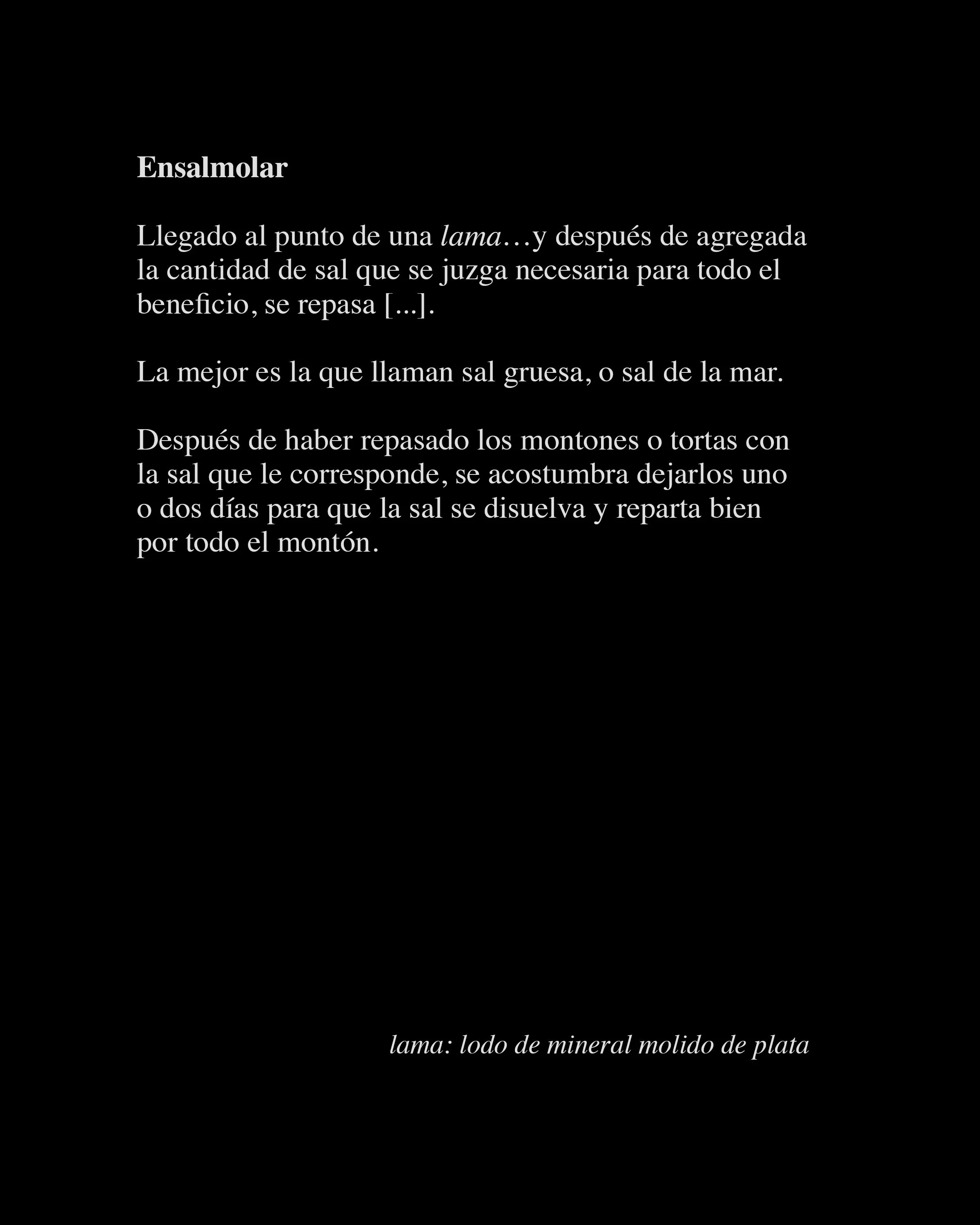
Once the material has reached the consistency of a lama…and the amount of salt deemed necessary for the entire treatment has been added, it is worked over again [...].
The best salt is what they call coarse salt, or sea salt.
After the heaps or cakes have been worked over with the appropriate amount of salt, they are usually left for one or two days so that the salt dissolves and spreads evenly throughout the heap.
Lama: slurry of finely ground silver ore
-
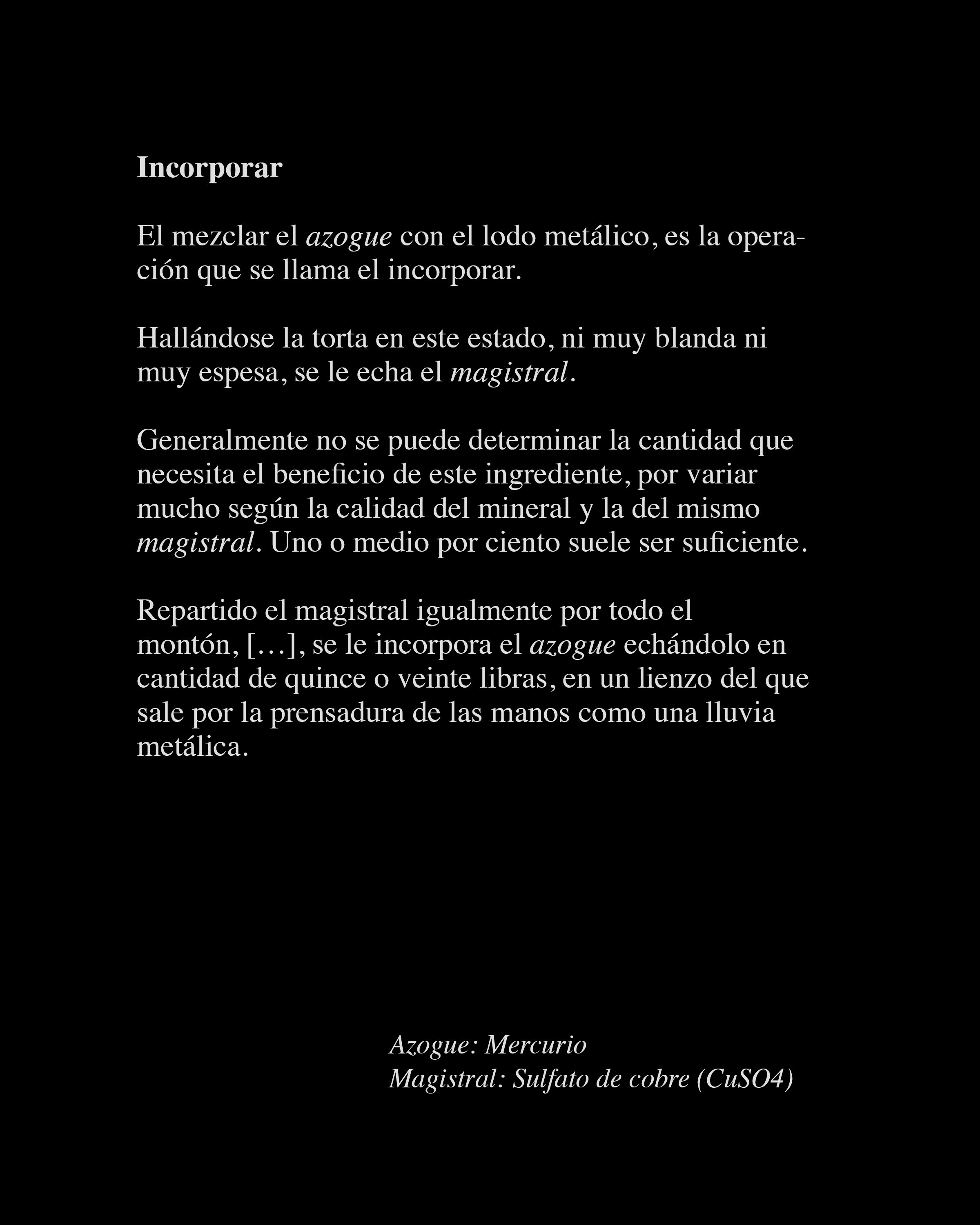
Mixing quicksilver with the ore slurry is the operation known as incorporation.
When the cake is in this state, neither too soft nor too thick, the magistral is added.
Generally, the amount of this ingredient required for treatment cannot be determined precisely, as it varies considerably according to the quality of the ore and of the magistral itself. One or half a percent is usually sufficient.
Once the magistral has been distributed evenly throughout the heap, […], the quicksilver is incorporated by pouring it, in quantities of fifteen or twenty pounds, into a linen cloth, through which it is squeezed by hand like a metallic rain.
Quicksilver: Mercury
Magistral: Copper sulfate (CuSO4) -
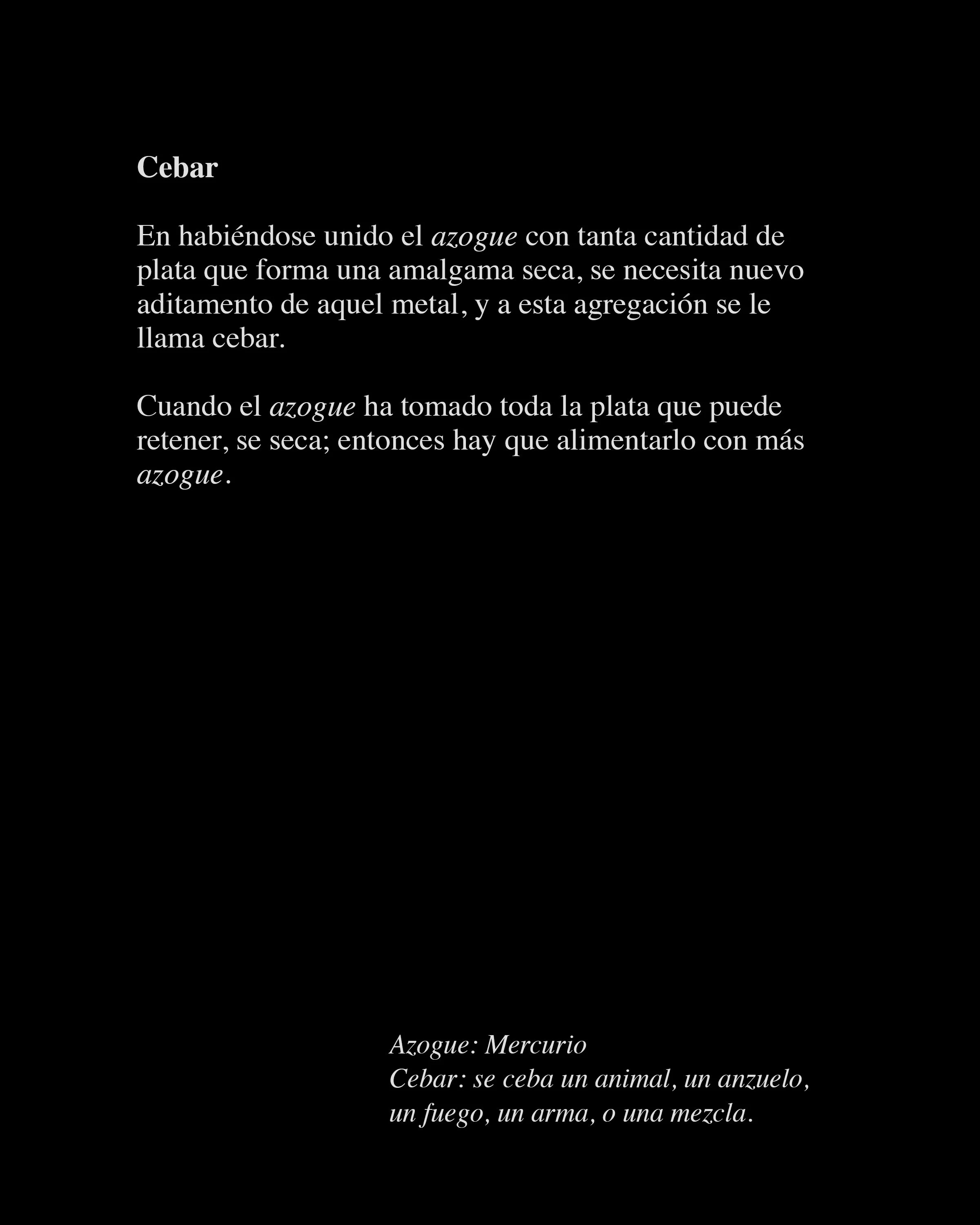
Once the quicksilver has combined with enough silver to form a dry amalgam, a further addition of that metal is needed, and this addition is called feeding.
When the quicksilver has taken up all the silver it can retain, it becomes dry; it must then be fed with more quicksilver.
Quicksilver: Mercury
Cebar: to feed an animal, bait a hook, fuel a fire, prime a weapon, or feed a mixture. -
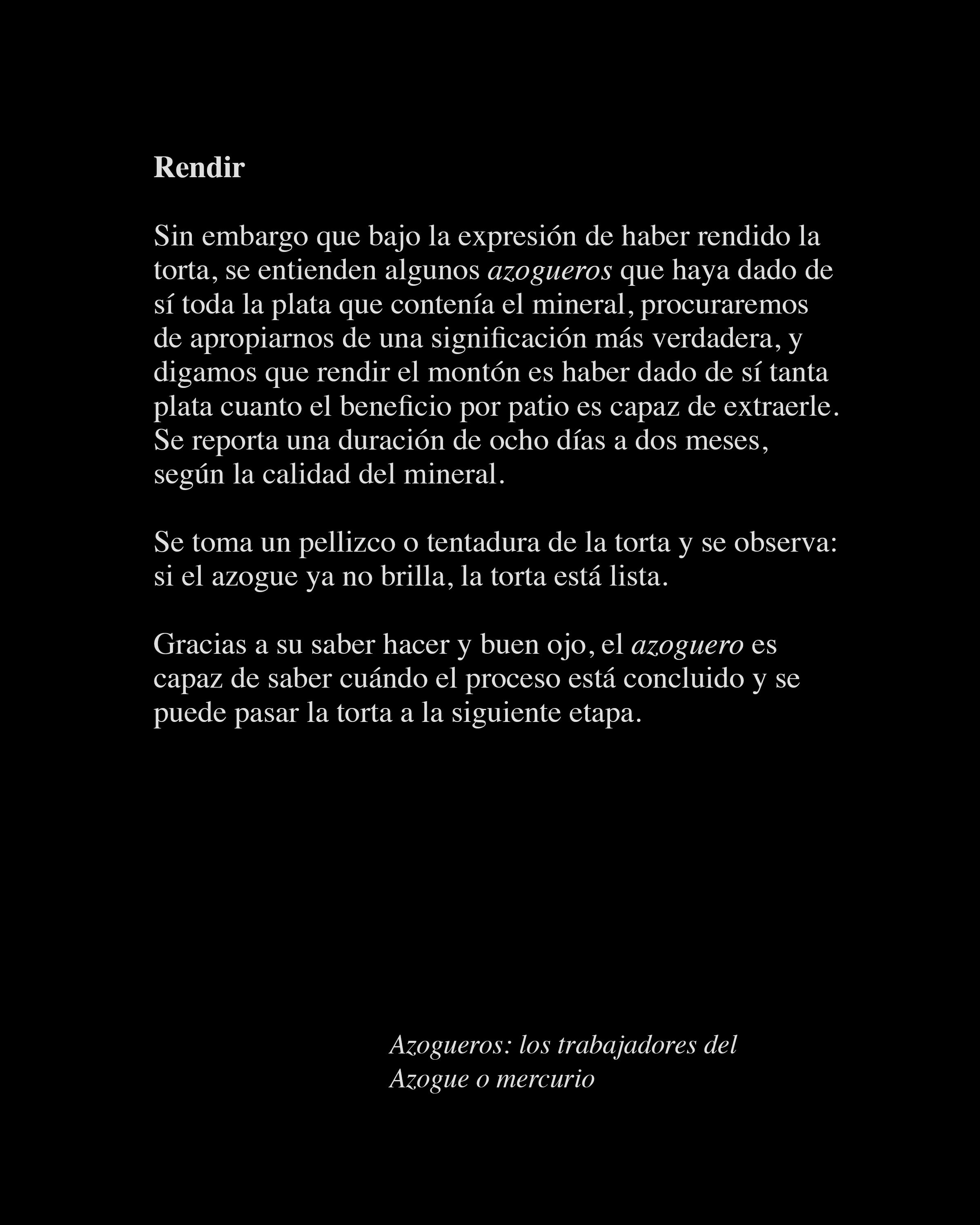
Although some amalgamators understand the expression “the cake has yielded” to mean that it has given up all the silver contained in the ore, we shall seek a more accurate meaning and say that a heap has yielded when it has given up as much silver as the patio process is capable of extracting. A duration of eight days to two months is reported, depending on the quality of the ore.
A pinch or test sample of the cake is taken and examined: if the quicksilver no longer shines, the cake is ready.
Through practical knowledge and a keen eye, the amalgamator can tell when the process is complete and the cake can move on to the next stage.
Amalgamators: workers who handle quicksilver or mercury
-
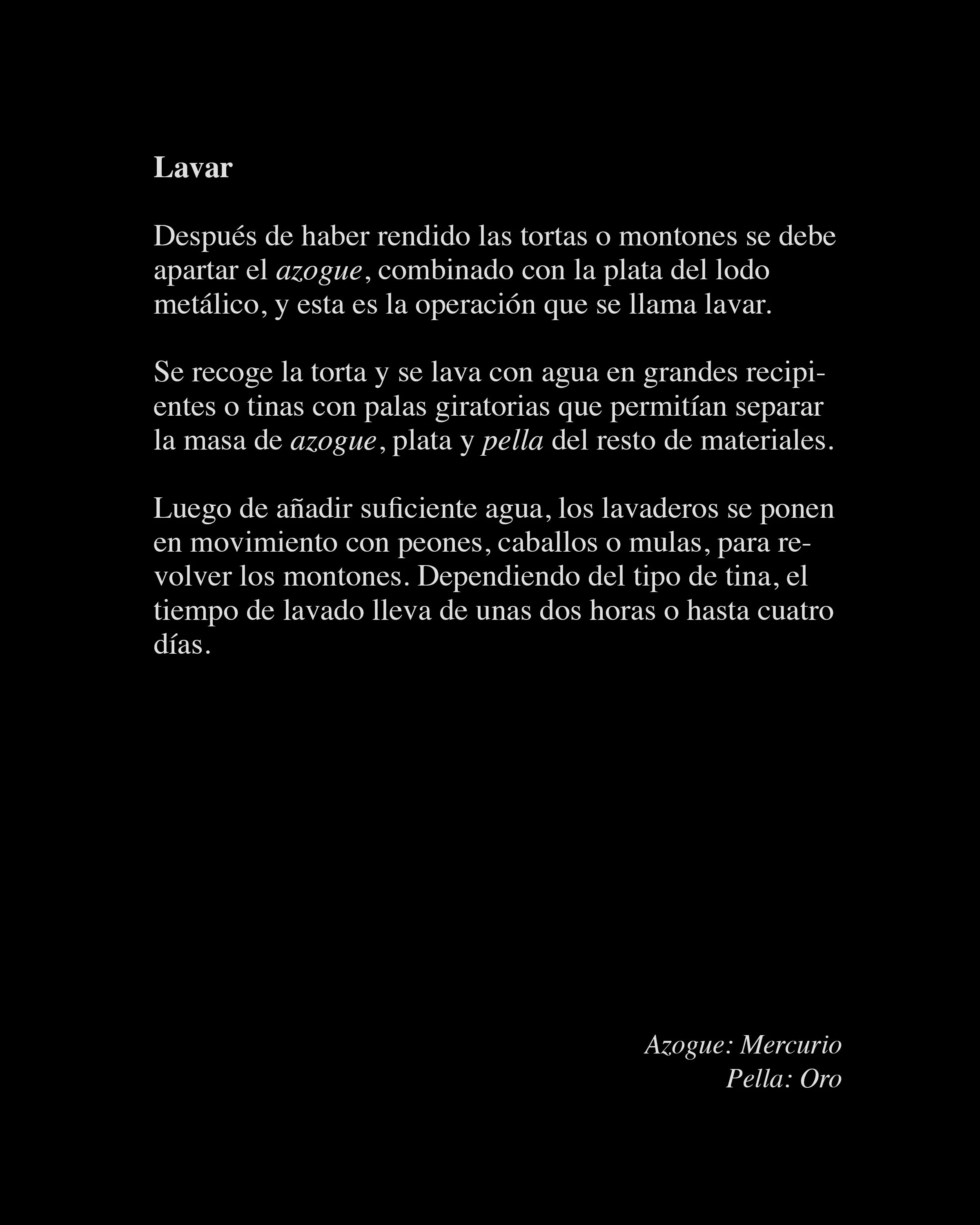
Once the cakes or heaps have yielded, the quicksilver, combined with the silver, must be separated from the ore slurry. This operation is called washing.
The cake is collected and washed with water in large vessels or vats with rotating paddles, which allowed the mass of quicksilver, silver, and pella to be separated from the remaining materials.
After sufficient water has been added, the washing apparatus is set in motion by laborers, horses, or mules to stir the heaps. Depending on the type of vat, washing takes anywhere from about two hours to four days.
Quicksilver: Mercury
Pella: Gold -
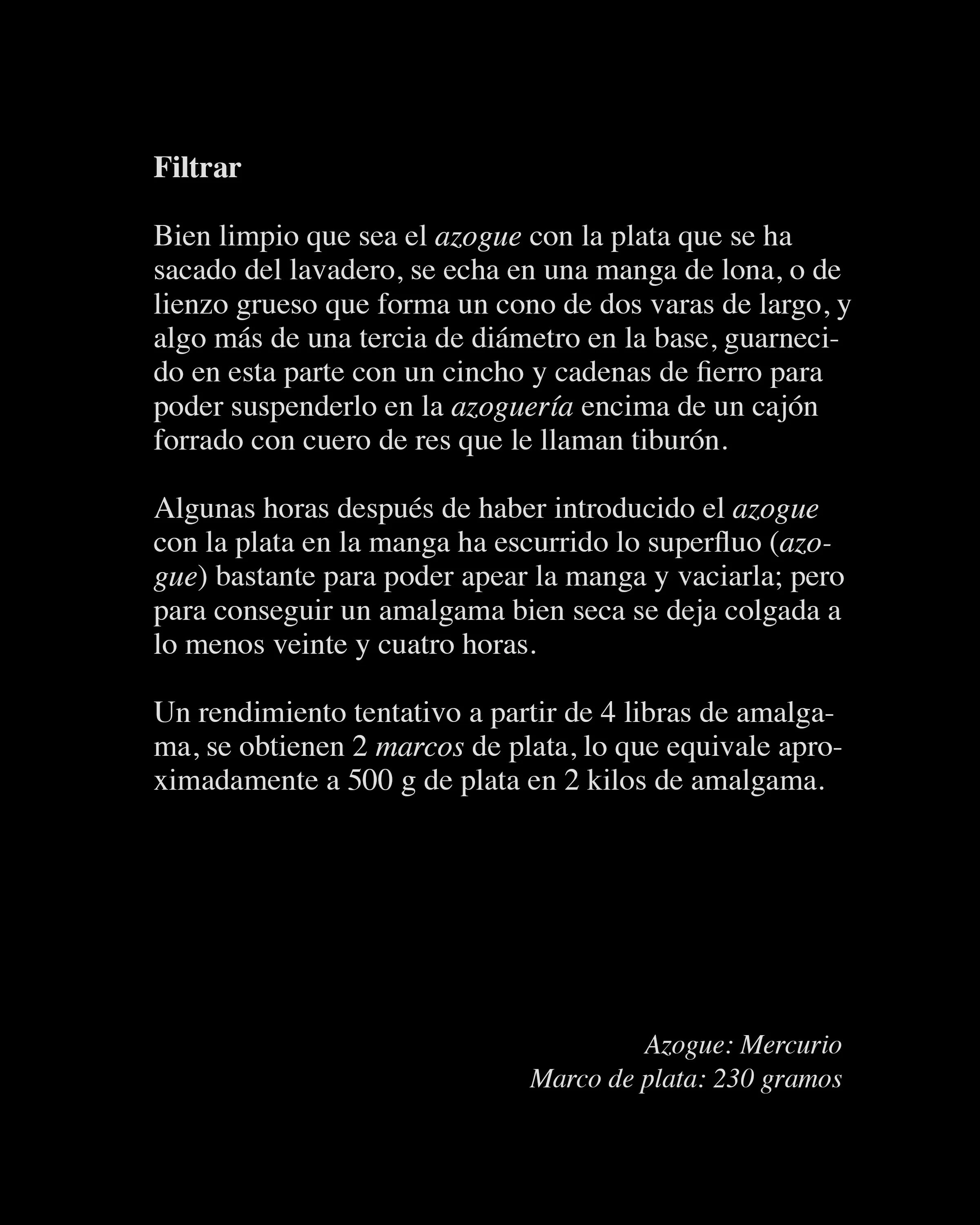
Once the quicksilver combined with silver has been thoroughly cleaned in the washing vat, it is poured into a canvas or heavy linen bag shaped like a cone, two varas long and slightly more than one-third of a vara in diameter at its base. At this end, it is fitted with a band and iron chains so that it can be suspended in the amalgamation workshop above a box lined with cowhide, which they call a “shark.”
A few hours after the quicksilver and silver have been introduced into the bag, enough of the excess (quicksilver) has drained away for the bag to be taken down and emptied; however, to obtain a thoroughly dry amalgam, it is left hanging for at least twenty-four hours.
An estimated yield from 4 pounds of amalgam is 2 marks of silver, equivalent to approximately 500 g of silver from 2 kilos of amalgam.
Quicksilver: Mercury
Silver mark: 230 grams -
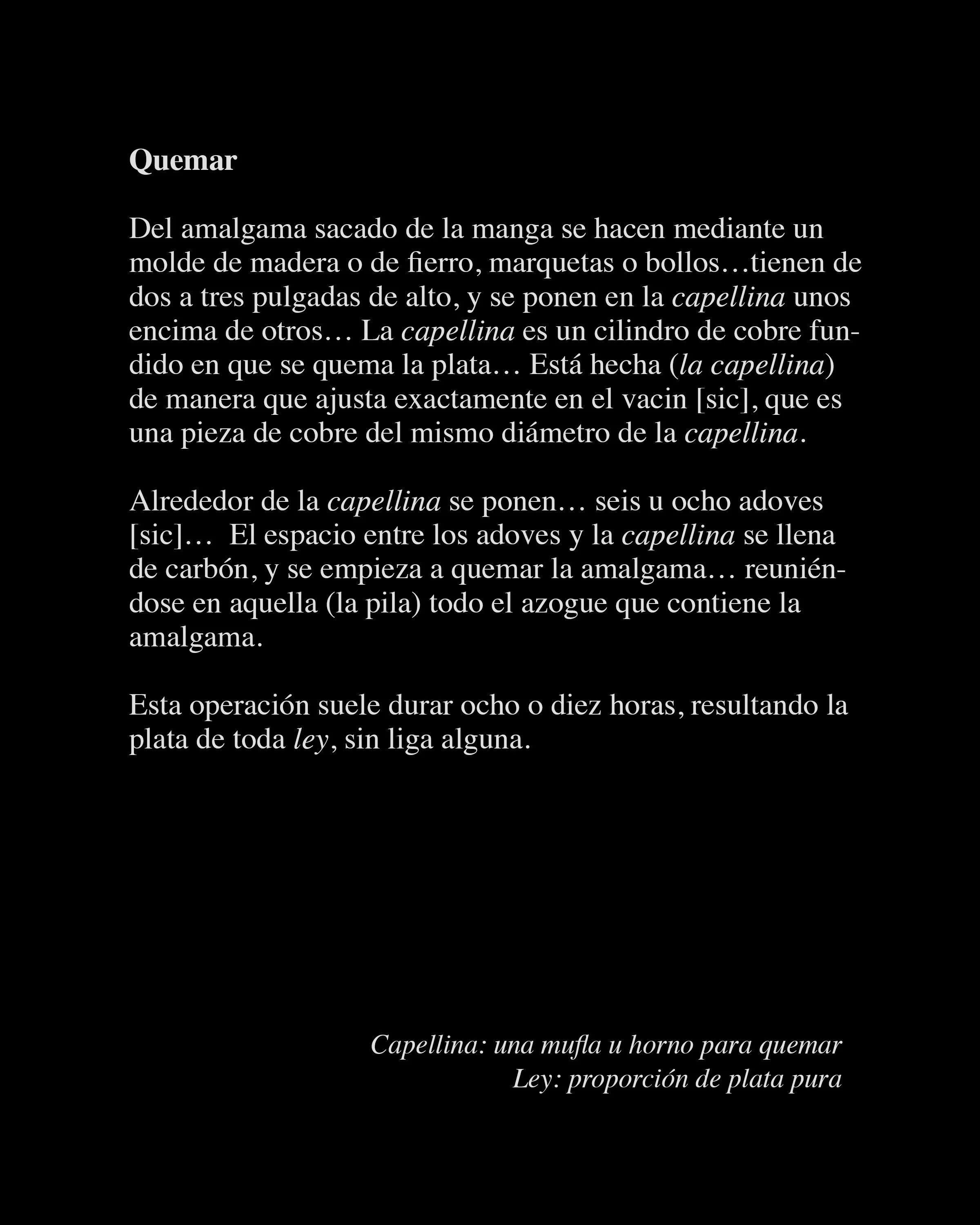
The amalgam taken from the bag is shaped into small blocks or lumps using a wooden or iron mold…these are two to three inches high and are placed in the capellina, one above another… The capellina is a cast-copper cylinder in which the silver is burned… It (the capellina) is made to fit exactly into the basin [“vacin,” sic], a copper piece of the same diameter as the capellina.
Around the capellina, six or eight adobe bricks [“adoves,” sic] are placed… The space between the bricks and the capellina is filled with charcoal, and the burning of the amalgam begins…all the quicksilver contained in the amalgam collects in that receptacle (the basin).
This operation usually lasts eight or ten hours, yielding silver of full fineness, without any alloy.
Capellina: a muffle or furnace for burning
Fineness: proportion of pure silver
Textos en Español
-
El proceso de extracción de la plata, descrito como recetas de cocina.
A partir del Tratado de la amalgamación de Nueva España, obra de Federico Sonneschmidt escrito en 1798 y publicado en 1825, en relación al método del patio.
El negro de esta página es plata pura. La ausencia de plata hace legibles los textos.ext goes here
-
Llegado al punto de una lama…y después de agregada la cantidad de sal que se juzga necesaria para todo el beneficio, se repasa [...]
La mejor es la que llaman sal gruesa, o sal de la mar.Después de haber repasado los montones o tortas con la sal que le corresponde, se acostumbra dejarlos uno o dos días para que la sal se disuelva y reparta bien por todo el montón.
-
El mezclar el azogue con el lodo metálico, es la operación que se llama el incorporar.
Hallándose la torta en este estado, ni muy blanda ni muy espesa, se le echa el magistral.
Generalmente no se puede determinar la cantidad que necesita el beneficio de este ingrediente, por variar mucho según la calidad del mineral y la del mismo magistral. Uno o medio por ciento suele ser suficiente.
Repartido el magistral igualmente por todo el montón, […], se le incorpora el azogue echándolo en cantidad de quince o veinte libras, en un lienzo del que sale por la prensadura de las manos como una lluvia metálica.
Azogue: Mercurio
Magistral: Sulfato de cobre (CuSO4) -
En habiéndose unido el azogue con tanta cantidad de plata que forma una amalgama seca, se necesita nuevo aditamento de aquel metal, y a esta agregación se le llama cebar.
Cuando el azogue ha tomado toda la plata que puede retener, se seca; entonces hay que alimentarlo con más azogue.
Azogue: Mercurio
Cebar: se ceba un animal, un anzuelo, un fuego, un arma, o una mezcla. -
Sin embargo que bajo la expresión de haber rendido la torta, se entienden algunos azogueros que haya dado de sí toda la plata que contenía el mineral, procuraremos de apropiarnos de una significación más verdadera, y digamos que rendir el montón es haber dado de sí tanta plata cuanto el beneficio por patio es capaz de extraerle. Se reporta una duración de ocho días a dos meses, según la calidad del mineral.
Se toma un pellizco o tentadura de la torta y se observa: si el azogue ya no brilla, la torta está lista.
Gracias a su saber hacer y buen ojo, el azoguero es capaz de saber cuándo el proceso está concluido y se puede pasar la torta a la siguiente etapa.
Azogueros: los trabajadores del Azogue o mercurio
-
Después de haber rendido las tortas o montones se debe apartar el azogue, combinado con la plata del lodo metálico, y esta es la operación que se llama lavar.
Se recoge la torta y se lava con agua en grandes recipientes o tinas con palas giratorias que permitían separar la masa de azogue, plata y pella del resto de materiales.
Luego de añadir suficiente agua, los lavaderos se ponen en movimiento con peones, caballos o mulas, para revolver los montones. Dependiendo del tipo de tina, el tiempo de lavado lleva de unas dos horas o hasta cuatro días.
Azogue: Mercurio
Pella: Oro -
Bien limpio que sea el azogue con la plata que se ha sacado del lavadero, se echa en una manga de lona, o de lienzo grueso que forma un cono de dos varas de largo, y algo más de una tercia de diámetro en la base, guarnecido en esta parte con un cincho y cadenas de fierro para poder suspenderlo en la azoguería encima de un cajón forrado con cuero de res que le llaman tiburón.
Algunas horas después de haber introducido el azogue con la plata en la manga ha escurrido lo superfluo (azogue) bastante para poder apear la manga y vaciarla; pero para conseguir un amalgama bien seca se deja colgada a lo menos veinte y cuatro horas.
Un rendimiento tentativo a partir de 4 libras de amalgama, se obtienen 2 marcos de plata, lo que equivale aproximadamente a 500 g de plata en 2 kilos de amalgama.
Azogue: Mercurio
Marco de plata: 230 gramos -
Del amalgama sacado de la manga se hacen mediante un molde de madera o de fierro, marquetas o bollos…tienen de dos a tres pulgadas de alto, y se ponen en la capellina unos encima de otros… La capellina es un cilindro de cobre fundido en que se quema la plata… Está hecha (la capellina) de manera que ajusta exactamente en el vacin [sic], que es una pieza de cobre del mismo diámetro de la capellina.
Alrededor de la capellina se ponen… seis u ocho adoves [sic]… El espacio entre los adoves y la capellina se llena de carbón, y se empieza a quemar la amalgama… reuniéndose en aquella (la pila) todo el azogue que contiene la amalgama.
Esta operación suele durar ocho o diez horas, resultando la plata de toda ley, sin liga alguna.
Capellina: una mufla u horno para quemar
Ley: proporción de plata pura
THE TRIP TO MEXICO
The Photo Circle
Latency
250 USD
One silver gelatin photograph.
36 × 28 cm (11 × 14 in)
Edition of 15.
Unframed
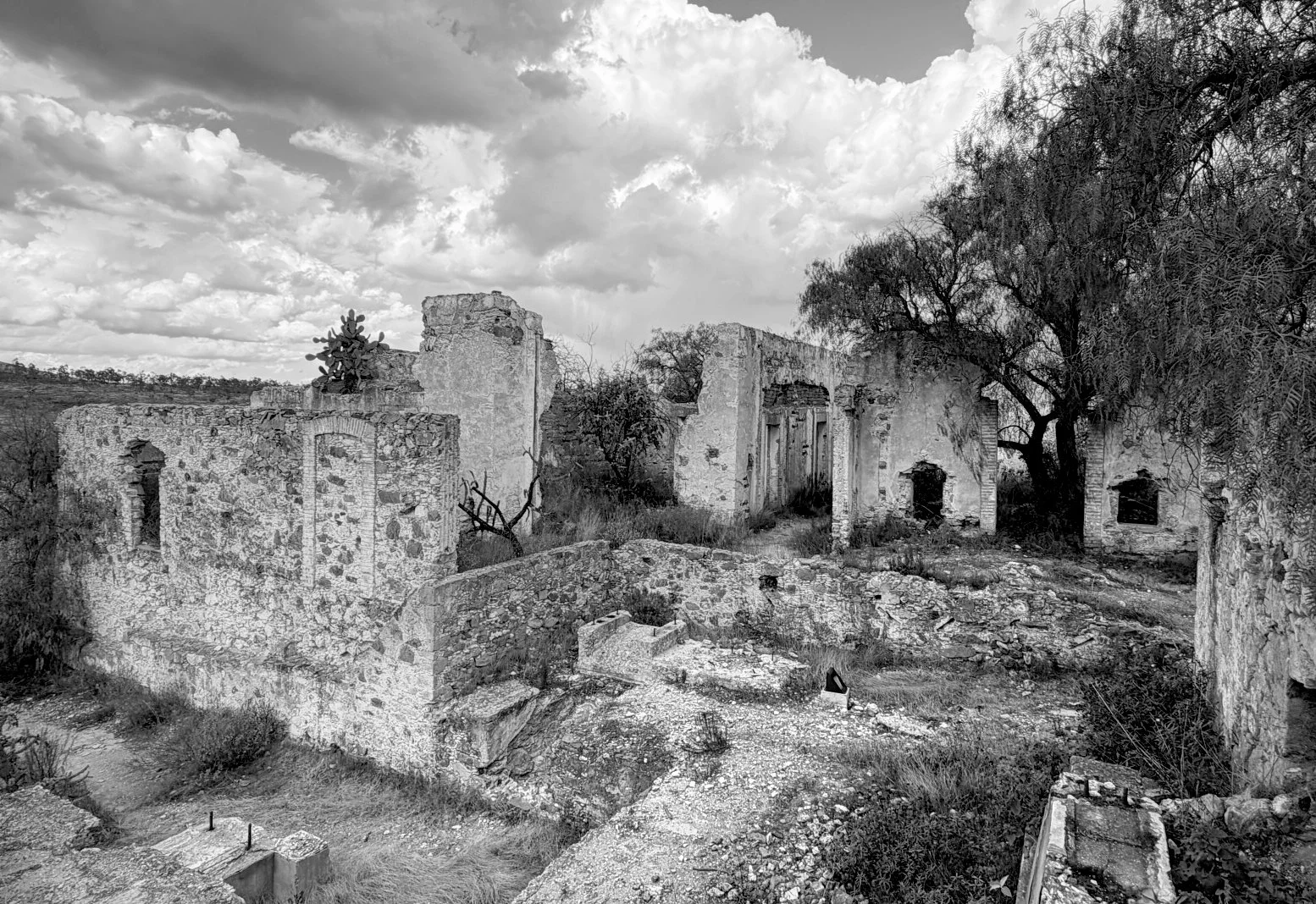
NOTE: These images will be produced during the trip to Mexico. The image is for reference only.
Also Included in this :
Two cards — Plata y Bermellón — and the welcome letter
Closing balance, printed and numbered, at the close of the cycle
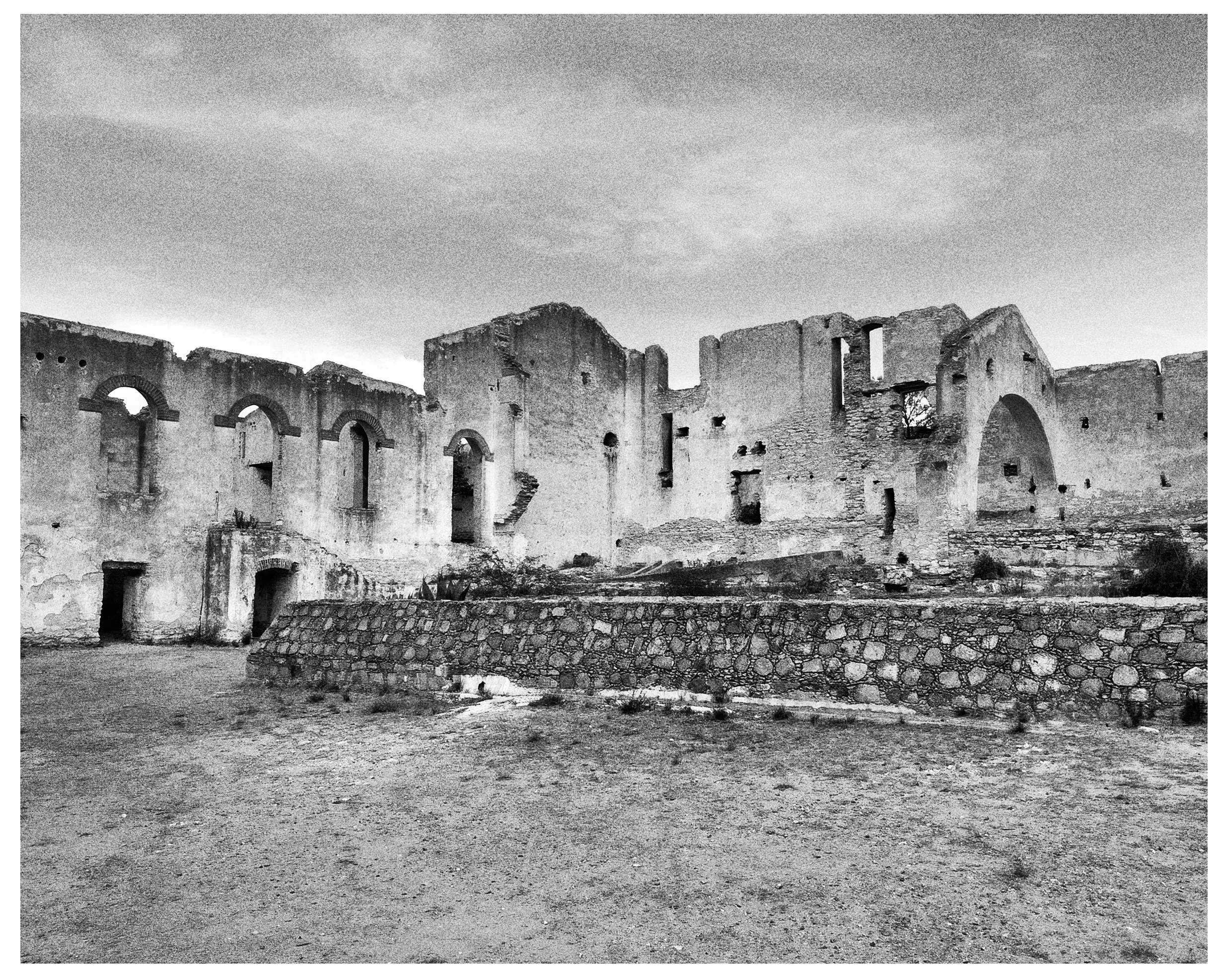
NOTE: I'll produce the image during my trip to Mexico. The image here is for reference only. It was taken with a digital camera on a trip I made to Mineral de Pozos, Guanajuato
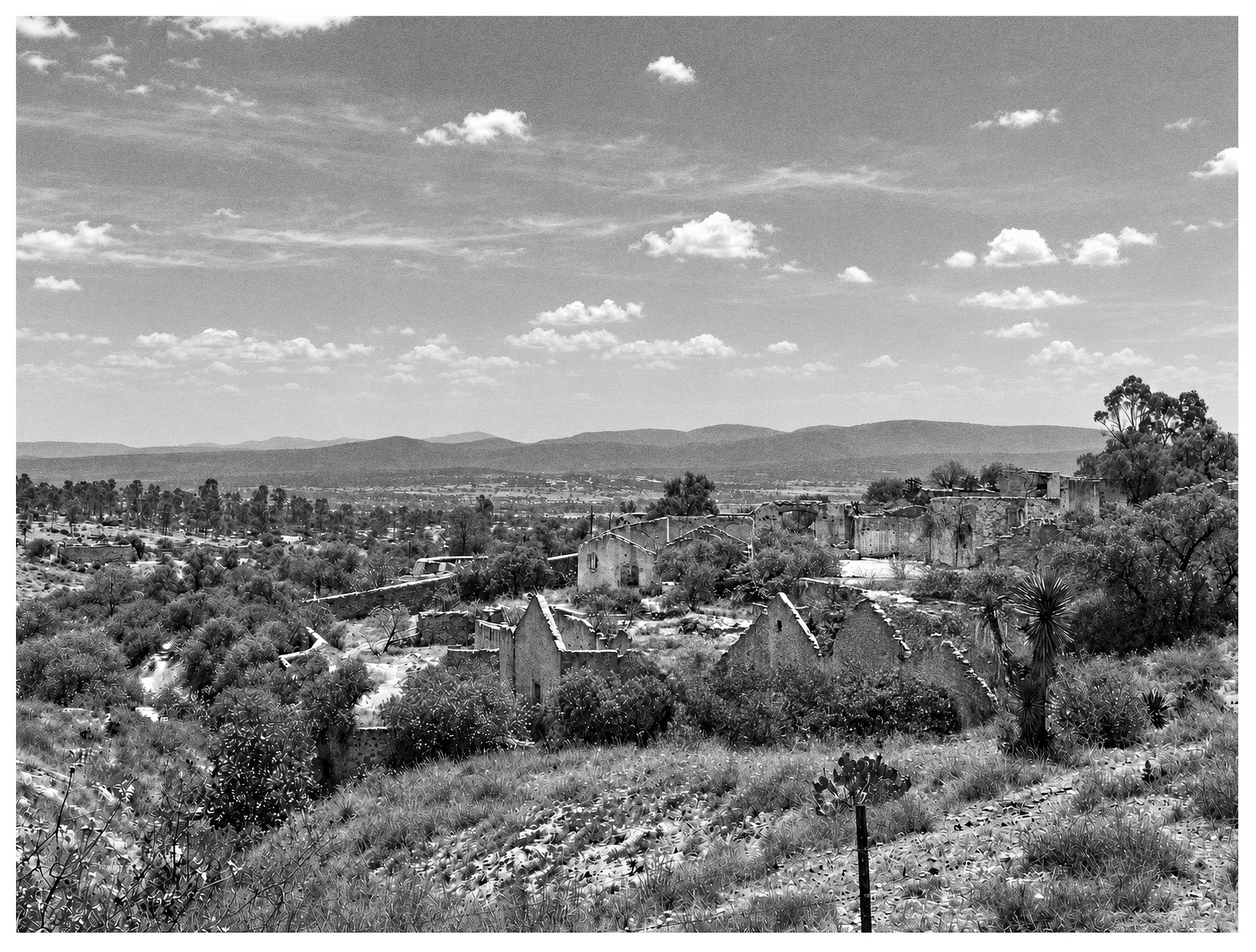
Your participation will make my trip possible. I will produce a series of photographs, from which you will be able to choose.
Thanks for trusting me to create interesting and new compelling images for you.
One photograph from the photo series made in abandoned mines in Guanajuato and Hidalgo. I’m looking for places that document the ruins of silver extraction in Mexico and the effects on the environment.
I'll shoot the images on a medium-format camera. The film is exposed in Mexico and travels back to Berlin undeveloped. For several weeks the image exists only as a latent one — a few atoms of silver on each crystal, invisible, and destroyable by any light that reaches it. Bringing it out is the entire purpose of the room this cycle builds.
Each print is stamped on the back with the weight of silver it holds. The fixer it passes through is kept, and the silver it carries away is recovered, weighed, and recorded in the closing balance.
Delivered Spring 2027.
Closing balance (certificate of silver accountability) sent when the cycle closes, and all works are delivered (estimated May 2027).
Shipping: Worldwide via certified post.
Mexico: Delivered locally in Mexico or by courier
One silver gelatin photograph.
36 × 28 cm (11 × 14 in)
Edition of 15.
Unframed
NOTE: These images will be produced during the trip to Mexico. The image is for reference only.
Also Included in this :
Two cards — Plata y Bermellón — and the welcome letter
Closing balance, printed and numbered, at the close of the cycle
Each print is stamped on the back with the weight of silver it holds. The fixer it passes through is kept, and the silver it carries away is recovered, weighed, and recorded in the closing balance.
Delivered Spring 2027.
Closing balance (certificate of silver accountability) sent when the cycle closes, and all works are delivered (estimated May 2027).
Shipping: Worldwide via certified post.
Mexico: Delivered locally in Mexico or by courier
The Fine Print Circle
Recovery
450 USD
One fine-print silver gelatin photograph on fibre paper
Taken on the trip to document abandoned silver mines in Mexico
One metallic silver nugget, recovered from the unused silver used to make this photograph and its unsuccessful copies.
Size: 40 × 50 cm (16 × 20 in)
Edition of 7. Unframed
NOTE: This image does not exist yet. They will result from my trip to Mexico at the end of January.
Also Included:
Two cards — Plata y Bermellón — and the welcome letter
Closing balance, printed and numbered, at the close of the cycle
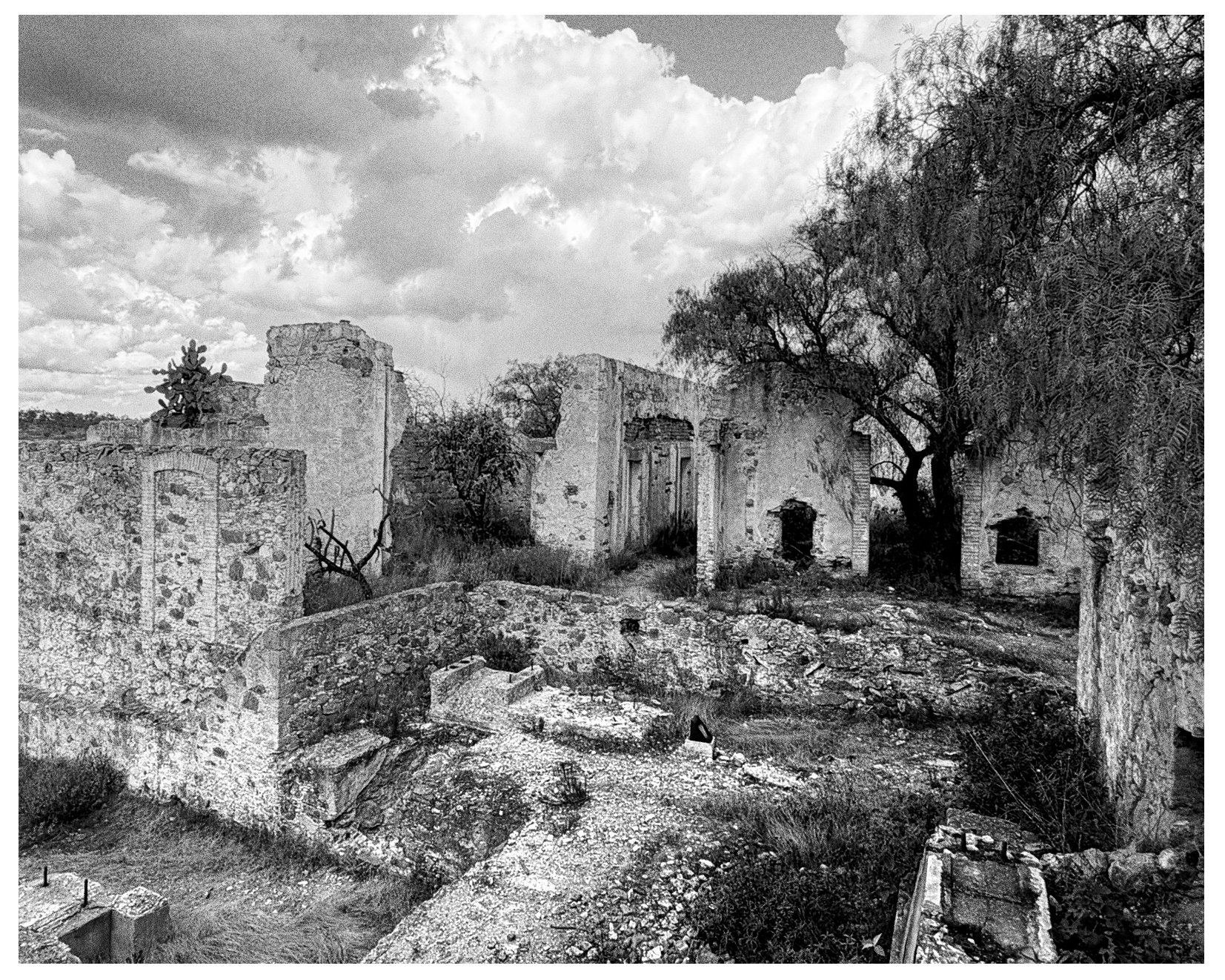
NOTE: This image is only an example and placeholder. It was taken with a digital camera on a trip I made to Mineral de Pozos. Your participation will make my trip possible: I will produce a series of photographs for you to choose from.
One fine-print silver gelatin photograph on fibre paper
Taken on the trip to document abandoned silver mines in Mexico
One metallic silver rock, recovered from the unused silver used to make this photograph and its unsuccessful copies.
Size: 40 × 50 cm (16 × 20 in)
Edition of 7. Unframed
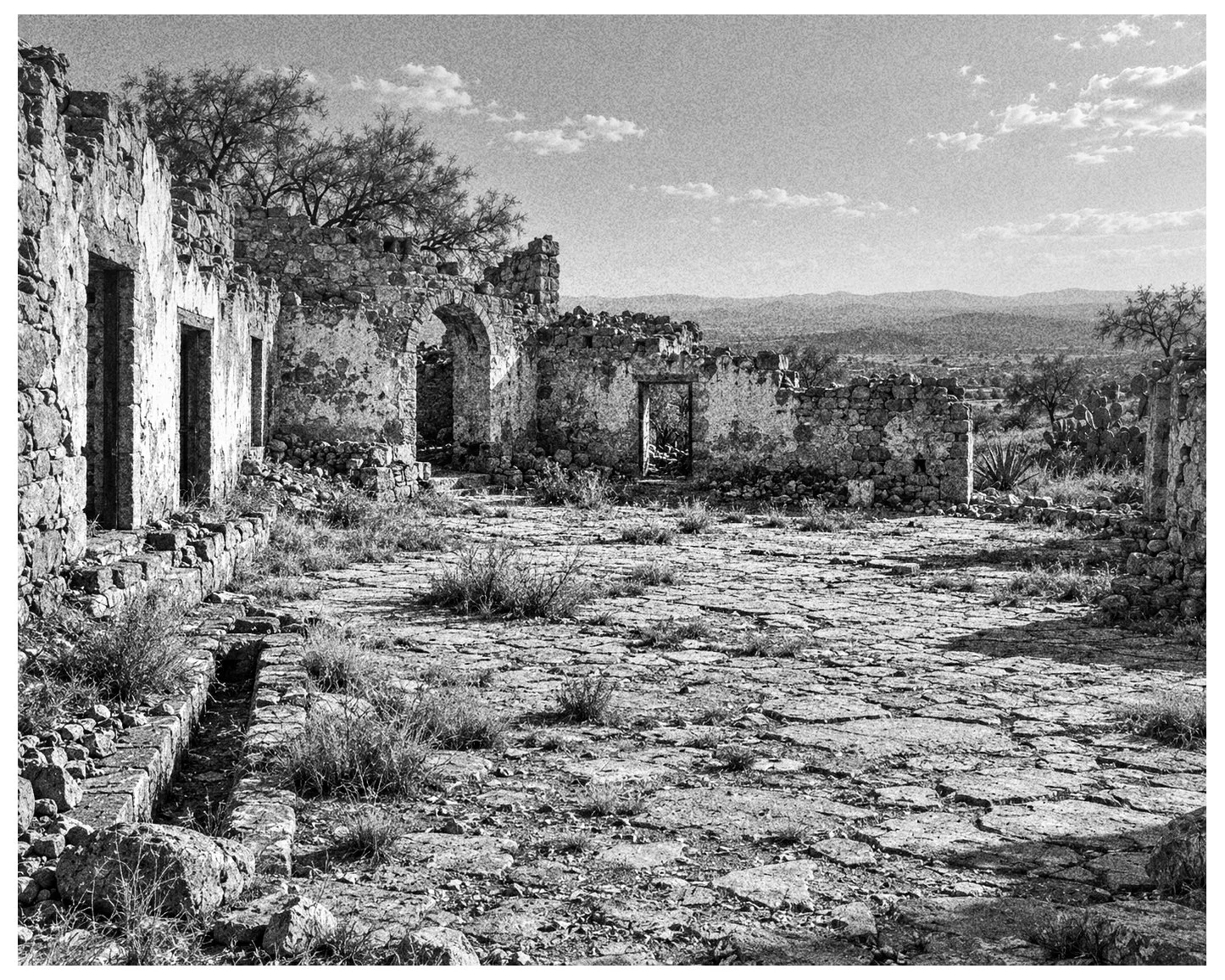
NOTE: This image does not exist yet. They will result from my trip to Mexico at the end of January.
Also Included:
Two cards — Plata y Bermellón — and the welcome letter
Closing balance, printed and numbered, at the close of the cycle
Each print is stamped on the back with the weight of silver it holds. The fixer it passes through is kept, and the silver it carries away is recovered, weighed, and recorded in the closing balance.
Delivered Spring 2027.
Closing balance (certificate of silver accountability) sent when the cycle closes, and all works are delivered (estimated May 2027).
Shipping: Worldwide via certified post or courier depending on destination.
Mexico: Delivered locally in Mexico or by courier
Silver nugget: The participants of this circle will receive a small rock (smaller than a grain of rice aprox) of recovered pure silver from the darkroom
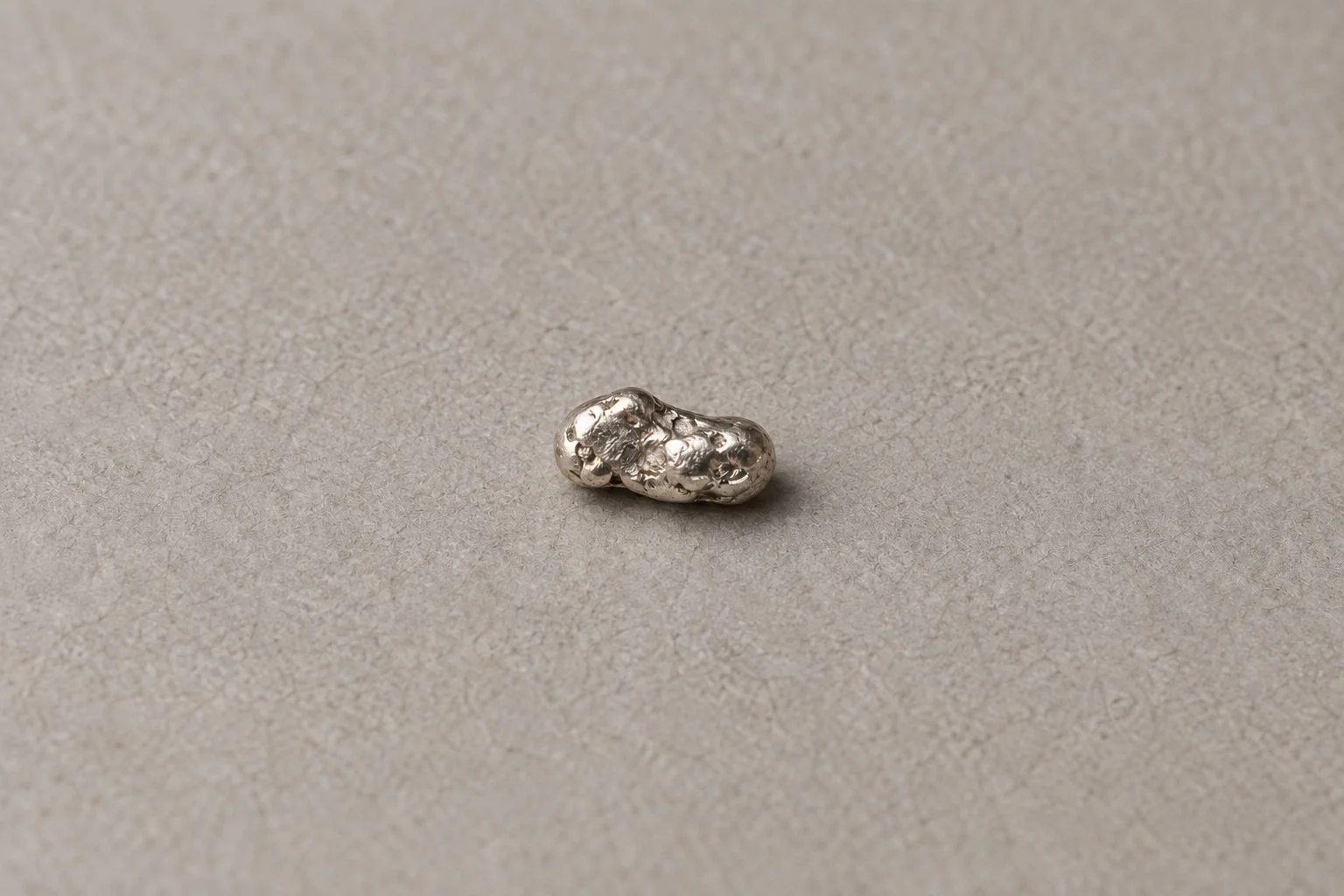
Thanks for trusting me to create interesting and new compelling images for you.
I think you will be surprised.
One photograph from the photo series made in abandoned mines in Mexico in Guanajuato and Hidalgo. I’m looking for places that document the ruins of silver extraction in Mexico and the effects on the environment.
I'll shoot these images with a medium-format camera. The film is exposed in Mexico and travels back to Berlin undeveloped. For several weeks the image exists only as a latent one — a few atoms of silver on each crystal, invisible, and destroyable by any light that reaches it. Bringing it out is the entire purpose of the room this cycle builds.
Each print is stamped on the back with the weight of silver it holds. The fixer it passes through is kept, and the silver it carries away is recovered, weighed, and recorded in the closing balance.
Delivered Spring 2027.
Closing balance (certificate of silver accountability) sent when the cycle closes, and all works are delivered (estimated May 2027).
Shipping: Worldwide via certified post or courier depending on destination.
Mexico: Delivered locally in Mexico or by courier
The Adquisition Circle
The Full Photo Essay
1700 USD
5 silver gelatin prints on fibre paper.
Taken on the trip to document abandoned silver mines in Mexico
One metallic silver nugget, recovered from the unused silver used to make this photograph and its unsuccessful copies.
Size: 5 images of 40 × 50 cm (16 × 20 in)
Edition of 5. Unframed
NOTE: These images do not exist yet. They will result from my trip to Mexico at the end of January.
Also Included:
One print from Silver Circle
Two cards — Plata y Bermellón — and the welcome letter
Closing balance, printed and numbered, at the close of the cycle
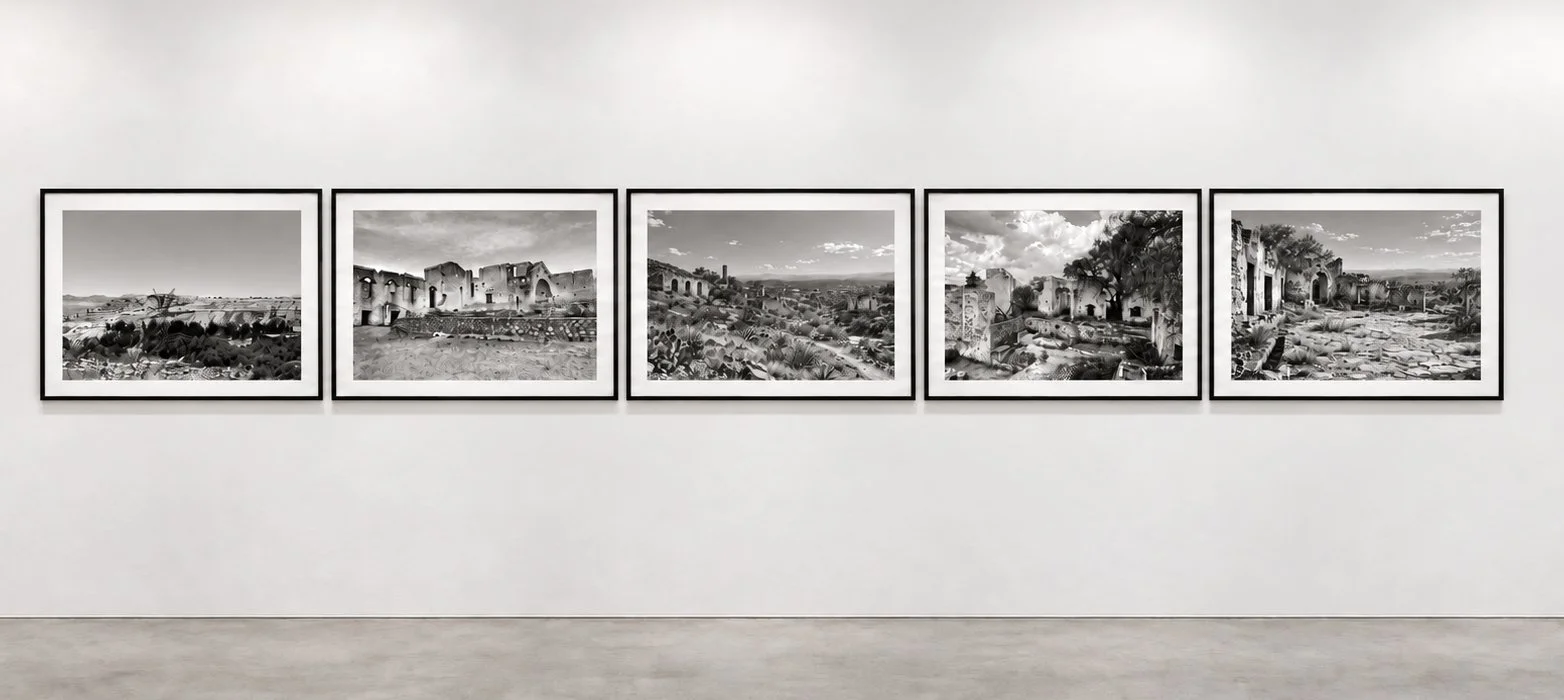
Visualisation: This is only a reference of how the work could look like after framing and hung on the wall.
Thanks for trusting me to create interesting and new compelling images for you.
Five photographs from the photo series made in abandoned mines in Guanajuato and Hidalgo, Mexico. I’m looking for places that document the ruins of silver extraction in Mexico and the effects on the environment.
I'll shoot the images on a medium-format camera. The film is exposed in Mexico and travels back to Berlin undeveloped. For several weeks the image exists only as a latent one — a few atoms of silver on each crystal, invisible, and destroyable by any light that reaches it. Bringing it out is the entire purpose of the room this cycle builds.
Each print is stamped on the back with the weight of silver it holds. The fixer it passes through is kept, and the silver it carries away is recovered, weighed, and recorded in the closing balance.
Delivered Spring 2027.
Closing balance (certificate of silver accountability) sent when the cycle closes, and all works are delivered (estimated May 2027).
Shipping: Worldwide via courier
Mexico: Delivered locally in Mexico or by courier
Contact me for info. You can join this circle directly with me in private or use the shopping cart for card processing.
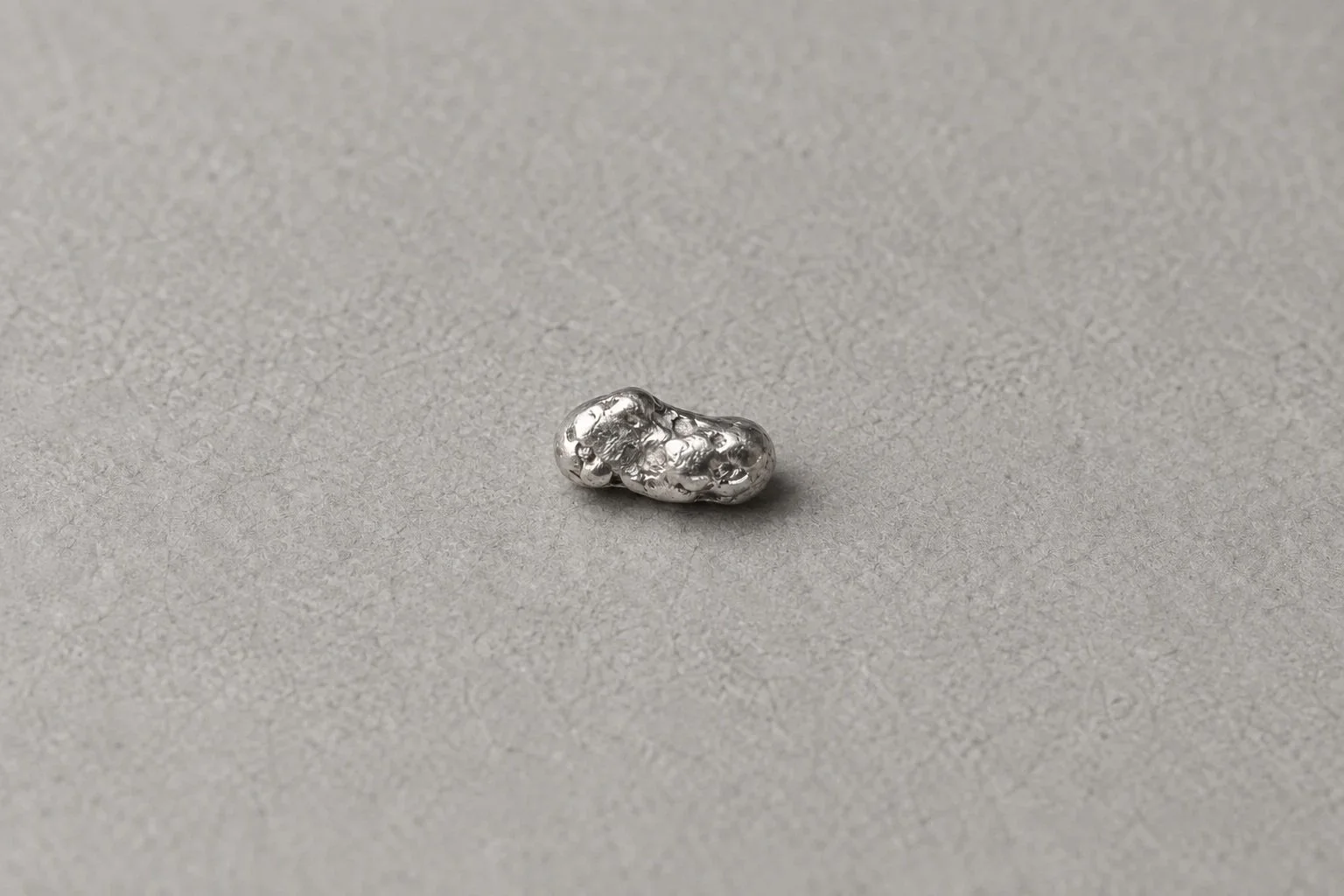
NOTE: This image is only an example and placeholder. It was taken with a digital camera on a trip I made to Mineral de Pozos. Your participation will make my trip possible: I will produce a series of photographs for you to choose from.
Silver nugget: The participants of this circle will receive a small nugget (size of a grain of rice aprox.) of recovered pure silver from developing these images.
5 silver gelatin prints on fibre paper.
Taken on the trip to document abandoned silver mines in Mexico
One metallic silver nugget, recovered from the unused silver used to make this photograph and its unsuccessful copies.
Size: 5 images of 40 × 50 cm (16 × 20 in)
Edition of 5. Unframed
NOTE: This image does not exist yet. They will result from my trip to Mexico at the end of January.
Also Included:
Two cards — Plata y Bermellón — and the welcome letter
Closing balance, printed and numbered, at the close of the cycle
Each print is stamped on the back with the weight of silver it holds. The fixer it passes through is kept, and the silver it carries away is recovered, weighed, and recorded in the closing balance.
Delivered Spring 2027.
Closing balance (certificate of silver accountability) sent when the cycle closes, and all works are delivered (estimated May 2027).
Shipping: Worldwide via courier
Mexico: Delivered locally in Mexico or by courier
The Balance Circle
__ grams of silver
1,800 USD
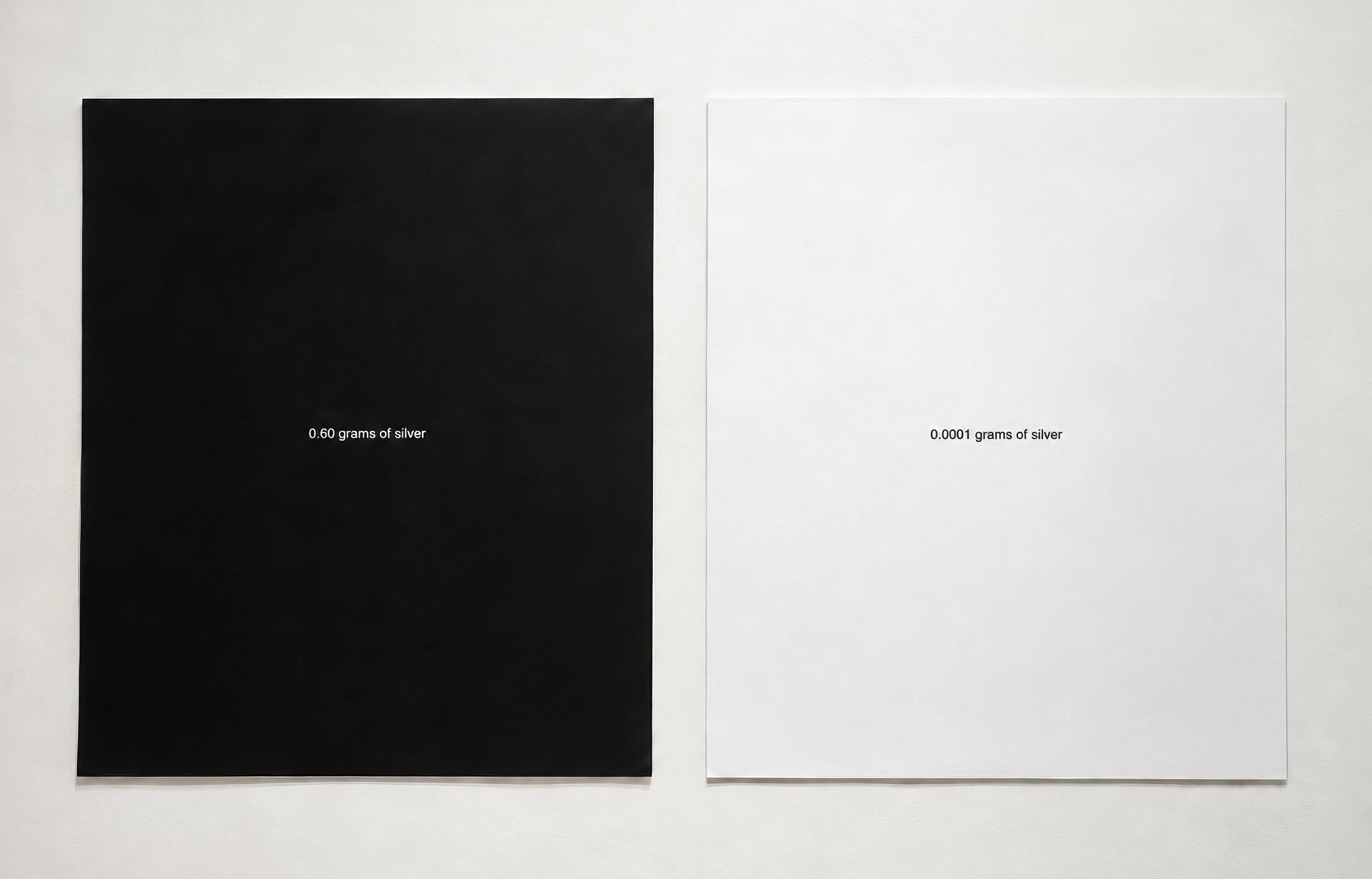
Visualisation: The weight in silver in this visualisation is approximate. The exact numbers will be printed accordingly in the delivered prints.
2 silver gelatin prints
Stating the amount of silver used to print them
50 × 60 cm (20 × 24 in) each
Edition of 5. Unframed
Also Included:
One print from Silver Circle
Two cards — Plata y Bermellón — and the welcome letter
Closing balance, printed and numbered, at the close of the cycle
Two photographs on the same silver gelatin paper, the same size, made in the same darkroom on the same afternoon, treated differently.
The first was fully exposed and developed. Every silver crystal it carried, except for the small letters, became metal and stayed there.
Except for the letters, the second was never exposed. It went into the fixer, and its silver dissolved out into solution. What hangs on the wall is the paper that remains with almost no silver.
Each panel carries, in small letters on its face, the silver it holds. The final work will include the exact numbers.
The silver is recovered from the fixer, weighed, and recorded against this work in the closing balance.
Delivered Spring 2027
Welcome Circle delivered in December 2026
Closing balance (certificate of silver accountability) sent when the cycle closes, and all works are delivered (estimated May 2027).
Shipping: Worldwide via courier
Mexico: Delivered locally in Mexico or by courier
Contact me for info. You can join this circle directly with me in private or use the shopping cart for card processing.
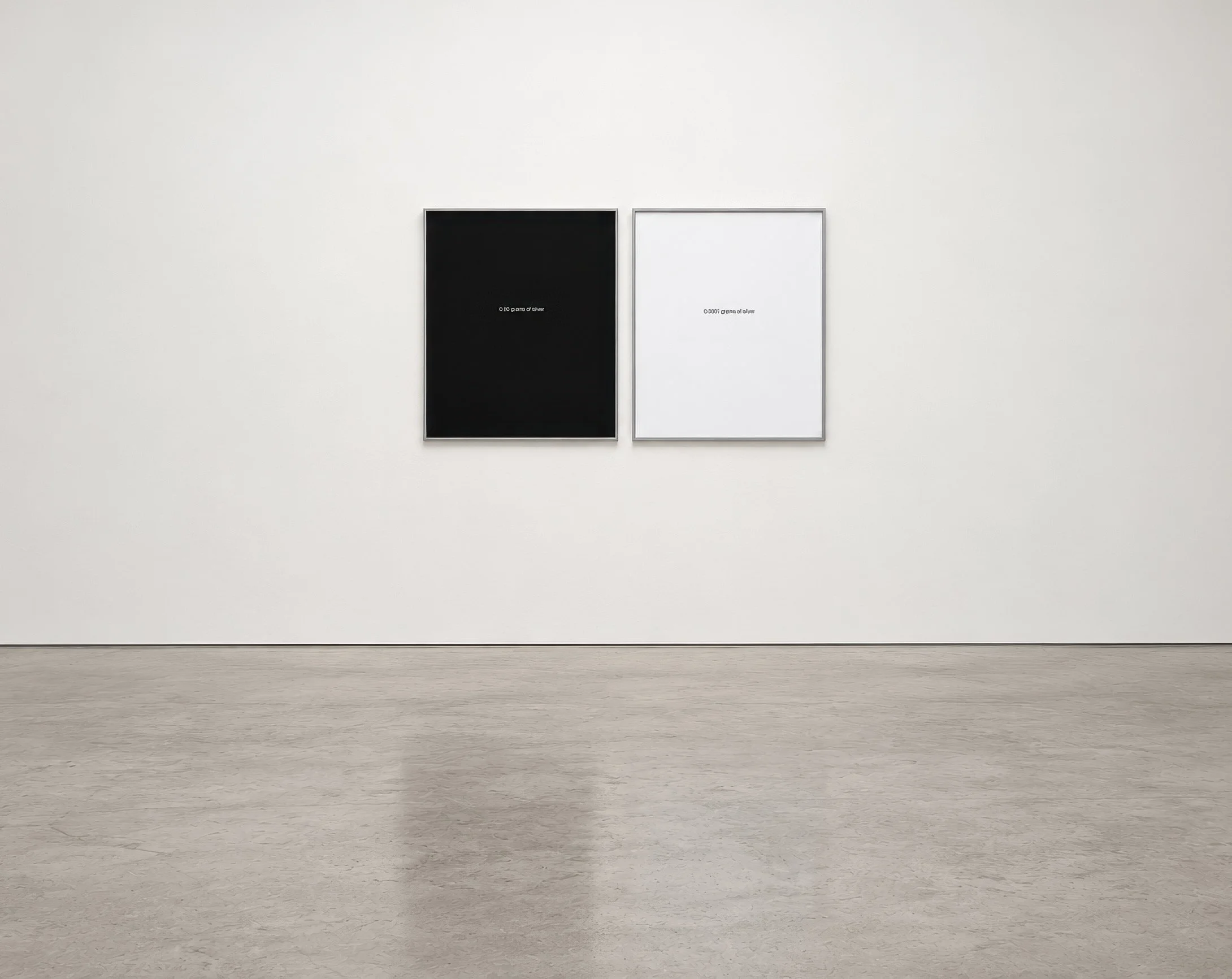
Visualisation: This is only a reference of how the work could look like after framing and hung on the wall.
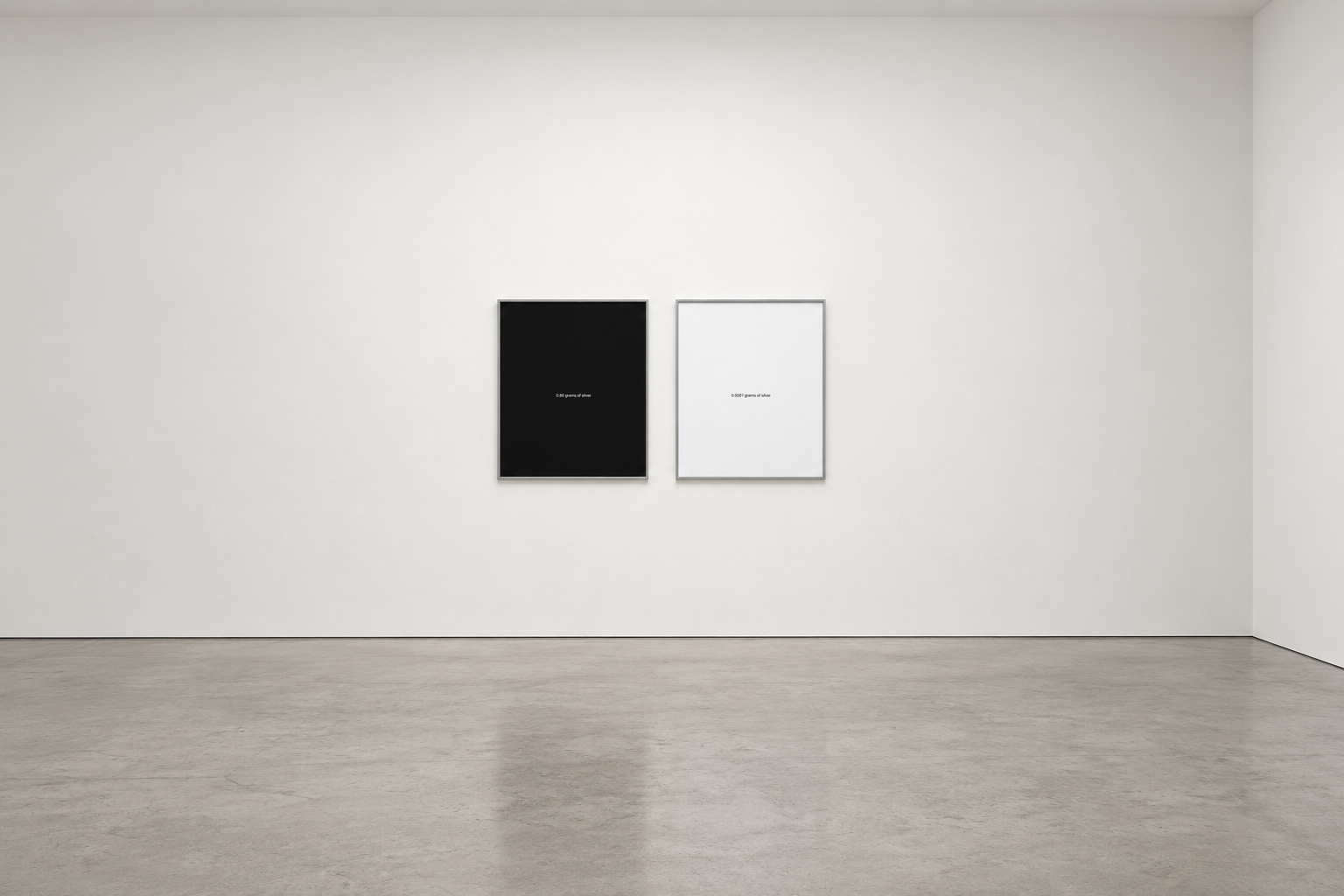
A diptych. Two panels of the same silver gelatin paper, the same size, made in the same darkroom on the same afternoon, treated in opposite ways.
The first was exposed to full light and developed. Every silver crystal it carried became metal and stayed there. Nothing can be taken back out of it.
The second was never exposed at all. It went straight into the fixer, and all of its silver dissolved out into solution. What hangs on the wall is the paper that remains.
Each panel carries, in small letters on its face, the silver it holds: 0.60 grams and 0.0001 grams. The distance between those two numbers is the distance between an image and what is discarded in order to make one — and it is the quantity this entire cycle follows, from forty thousand tonnes down to a hand.
The silver that left the second panel is not lost. It is recovered from the fixer, weighed, and its weight recorded against this work.
[Dimensions] · Framed · Edition of [n] · Signed and dated
Delivered December 2026, before the rest of the cycle exists.
Why silver, and what it costs: [essay]
This circle is arranged directly — write to me.
If you have any questions on this funding cyle, please contact me directly or fill out the contact page. Thanks so much for being part of this first circle
You can also support Curiosity Labs Berlin by considering other works by Emilio Chapela
Contact me directly for more information or fill out the contact form.
Other works
In connection with ecological thinking and processes
Boya. 2026. Cement. Emilio Chapela
Socavón (pothole). 2026. Acrylic on canvas. Emilio Chapela